

AI Agents vs AI Copilots in 2026: Who Is Actually Running Your Marketing Team?
-
Neelam Jadon
- 13 Feb 2026
-
- 13 Feb 2026
By 2026, artificial intelligence is no longer just assisting marketing teams -it is actively shaping how they operate. From SEO strategy to paid advertising optimization, AI has evolved beyond simple productivity tools into systems capable of real-time decision-making.
But not all AI works the same way.
Some tools function as intelligent assistants, helping marketers analyze data and generate ideas. Others operate with defined goals, executing complex workflows and optimizing campaigns autonomously.
Understanding this distinction is critical for SEO professionals and performance marketers. The difference between assisted execution and autonomous optimization directly impacts ranking stability, ad efficiency, scalability, and overall return on investment.
In today’s marketing landscape, the real competitive edge doesn’t come from using AI -it comes from understanding which type of AI is powering your strategy.
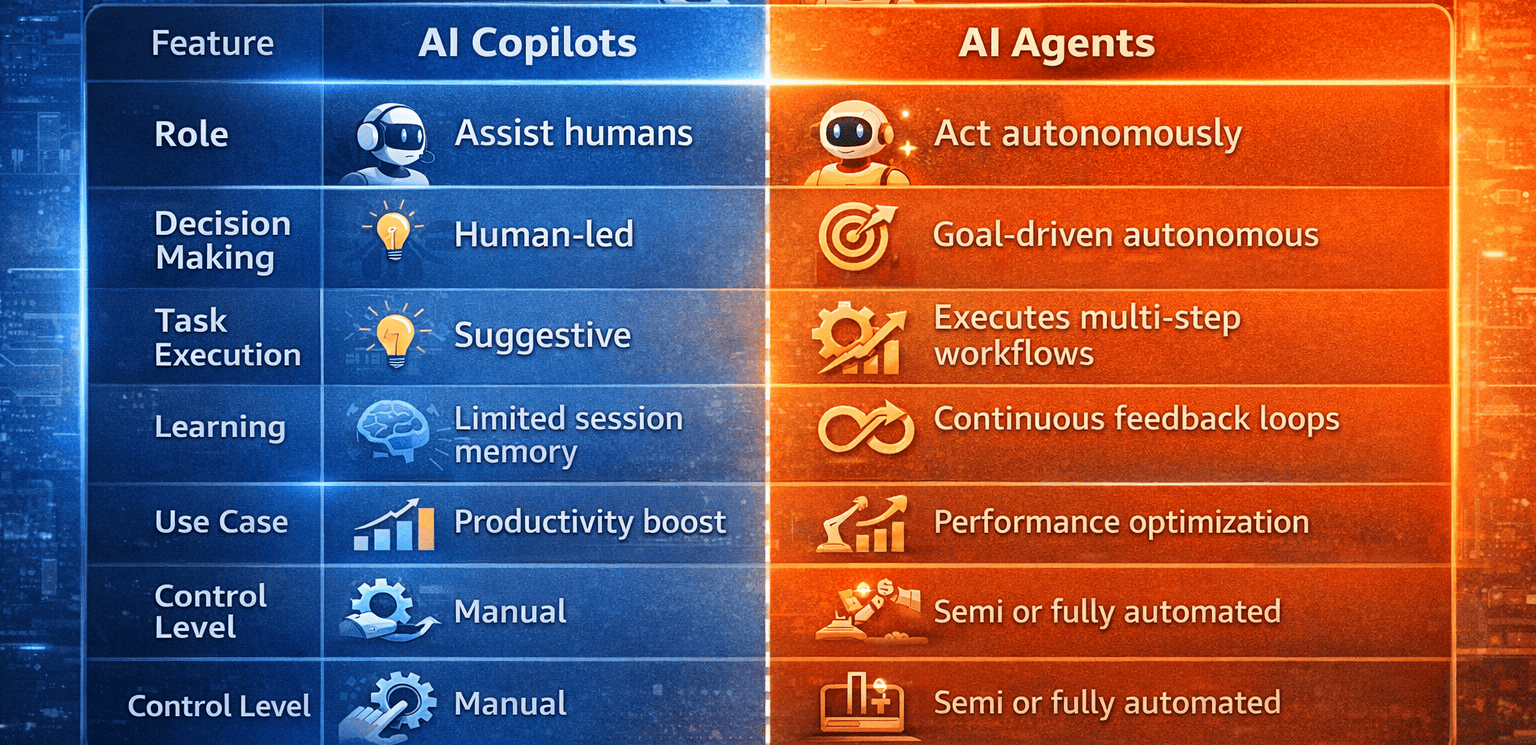
Let’s simplify it with a strategic comparison
How AI Agents Are Transforming SEO and Ad Optimization
Let’s move beyond theory and look at how this shift is practically affecting marketing teams.
1. Keyword Strategy Is Now Machine-Led
Earlier, SEO specialists manually clustered keywords and tried to interpret search intent. This process was time-consuming and often subjective.
AI agents now analyze massive keyword datasets instantly. They detect semantic relationships, classify intent (informational, commercial, transactional), and map those clusters to content gaps on your site. Instead of guessing what Google wants, the system continuously learns from ranking data and adjusts the content structure accordingly.
This results in stronger topical authority and higher-ranking probability.
2. Content Briefs Are Generated from Live SERP Intelligence
Creating a high-quality content brief traditionally required competitor research, SERP analysis, heading evaluation, and entity extraction.
AI agents now perform all of this in real time. They scan top-ranking pages, identify recurring semantic entities, detect featured snippet patterns, and structure outlines accordingly.
Writers no longer start from scratch. They start from optimized intelligence. That dramatically reduces content inefficiency.
3. On-Page SEO Becomes Continuous, Not Manual
In the past, SEO audits were periodic. A team would run a crawler, identify issues, fix them, and repeat after months.
AI agents now monitor websites continuously. They detect metadata weaknesses, internal linking gaps, schema errors, and crawl inefficiencies - and implement fixes automatically within defined governance rules.
SEO is no longer reactive. It becomes a live optimization layer.
4. Ad Spend Optimization Happens in Real Time
Manual bid adjustments are slow compared to auction dynamics.
AI agents monitor auction signals, competitor bidding behavior, conversion data, and user engagement metrics 24/7. They reallocate budgets across campaigns, pause underperforming segments, and scale high-ROI audiences automatically.
The difference is not small.
Copilots suggest budget changes.
Agents execute budget reallocation instantly.
That is where performance lift happens.
5. Creative Testing Is Now Scaled Intelligently
Running A/B tests manually limits experimentation speed.
AI agents generate multiple variations of ad creatives tailored to micro-segments. They test headlines, emotional triggers, call-to-actions, and visual combinations simultaneously. Based on engagement and conversion data, they refine future creatives autonomously.
Instead of testing 3 variations, brands test 300.
This increases conversion optimization depth significantly.
6. Cross-Channel Attribution Becomes Smarter
Modern customer journeys are not linear. Users interact with multiple channels before converting.
AI agents aggregate data across organic search, paid ads, social, email, and display. They build probabilistic attribution models that identify which touchpoints truly influence conversions.
This prevents budget misallocation and improves marketing ROI accuracy.
AI Agents vs AI Copilots: Which Should You Use?
If your goal is faster execution with human control, AI copilots are sufficient.
If your goal is performance maximization with scalable automation, AI agents are necessary.
The most competitive marketing teams in 2026 use both - but agents drive optimization engines.
Final Strategic Verdict
In 2026, AI copilots enhance productivity, but AI agents drive performance. The brands that lead won’t be the ones with bigger teams - they’ll be the ones powered by smarter autonomous systems. Competitive advantage will not come from simply using AI, but from understanding whether your marketing engine is assisted by tools or driven by intelligent agents built to optimize and scale.
Frequently Asked Questions (FAQ)
1.What is the difference between AI agents and AI copilots in marketing?
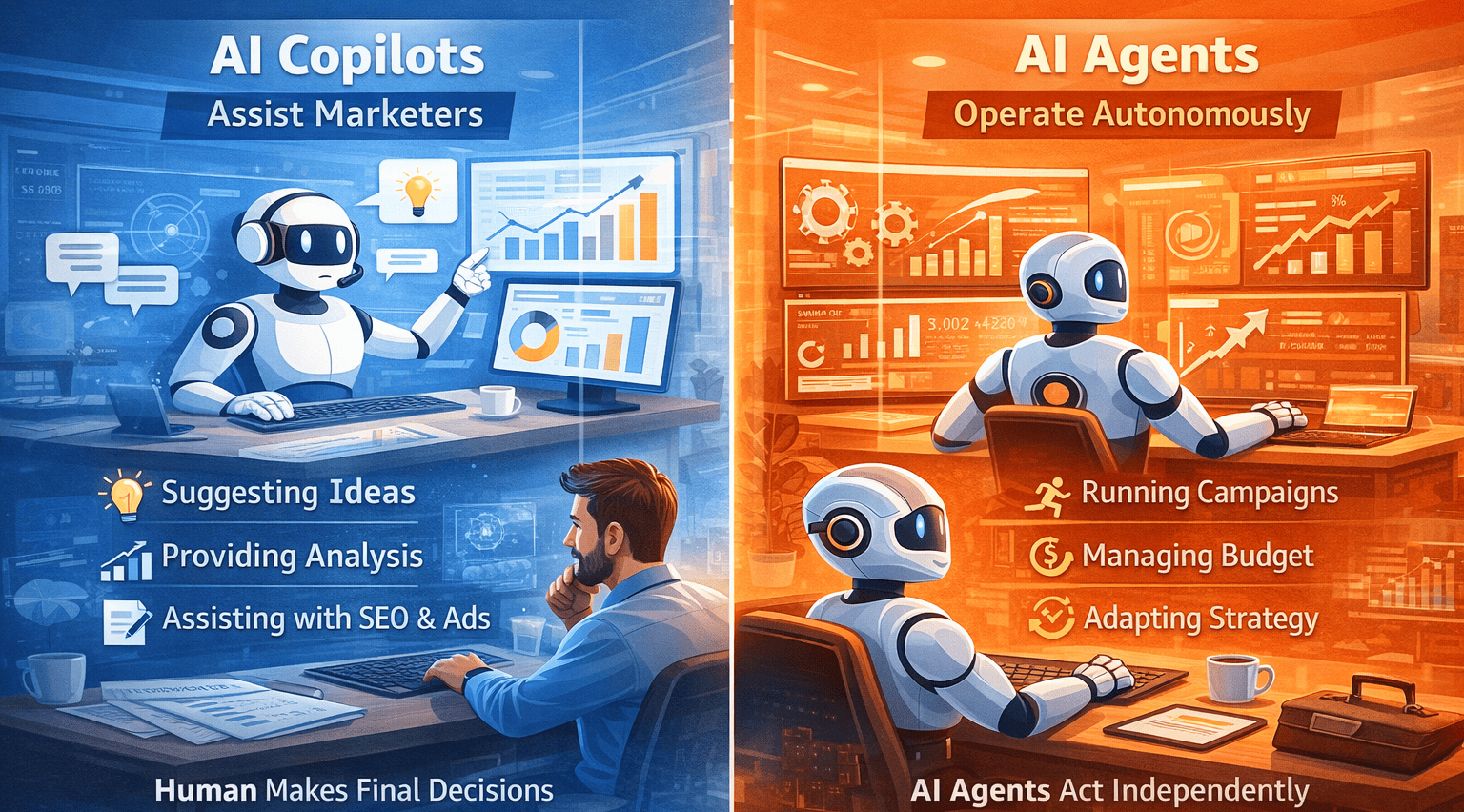
AI copilots assist marketers by suggesting ideas, analyzing data, and generating content, but humans make final decisions. AI agents operate autonomously, executing multi-step workflows, optimizing campaigns, and adapting strategies in real time based on predefined goals and performance feedback loops.
2.Are AI agents replacing digital marketers in 2026?
No, AI agents are not replacing marketers. They are automating repetitive execution tasks like bid management, reporting, and keyword clustering. Human marketers still define strategy, brand voice, positioning, ethical boundaries, and long-term growth direction.
3.How do AI agents improve SEO performance?
AI agents improve SEO by automatically clustering keywords, detecting search intent, optimizing on-page elements, identifying content gaps, and monitoring ranking fluctuations continuously. This reduces manual effort and increases topical authority, ranking stability, and organic traffic growth over time.
4.Can AI agents manage Google Ads automatically?
Yes. AI agents can monitor auction data, adjust bids in real time, reallocate budgets across campaigns, test multiple ad creatives, and pause underperforming segments automatically. This leads to faster optimization cycles and improved return on ad spend (ROAS).
5.What is agentic AI in digital marketing?
Agentic AI refers to autonomous AI systems designed to achieve defined goals without constant human supervision. In digital marketing, agentic AI can optimize SEO strategies, manage paid ads, analyze attribution models, and improve campaign performance continuously.
6.Which is better for marketing automation: AI agents or AI copilots?
AI copilots are better for improving productivity and assisting with tasks. AI agents are better for performance-driven marketing automation because they execute optimization strategies autonomously and adapt based on real-time data.
