
Content Gets Them In, Participation Multiplies
Lessons from Cannes Lions 2026 Grand Prix Winners
Every year, the Cannes Lions Festival of Creativity hands out its highest honor, the Grand Prix, to campaigns the jury believes redefine what creativity in marketing can do. In 2026, a pattern cut across almost every winner’s circle: the campaigns that won big did not just get attention. They got audiences to act, build, remix, and show up again. Content opened the door. Participation is what multiplied the result.
This matters well beyond the awards stage. Whether you are running content strategy for a SaaS platform, a B2B services firm, or a consumer brand, the winning campaigns at Cannes Lions 2026 offer a practical playbook: a KitKat heist that turned 115 competing brands into unpaid participants, a Vaseline sub-brand that let a community’s hacks define the product, a livestreaming platform that treats participation as core infrastructure rather than a campaign layer, and a sports media operation built entirely around fan-generated content. Each is a different mechanic pointed at the same insight — content gets people in the door, but participation is what turns a moment into momentum.
Key Stat
The global creator economy is on track to grow from roughly $252 billion in 2025 to over $1.3 trillion by 2033 — a 23.3% compound annual growth rate. Cannes Lions 2026’s Grand Prix winners were early proof that participation, not just reach, is where that value is being created.
What Is Participation Marketing, and Why Did It Dominate Cannes 2026
Participation marketing is a content and campaign approach where the audience’s contribution — their attention, their creativity, their voice, or their community — becomes a visible, credited part of the campaign itself. It is different from simple engagement marketing (likes, comments, shares as vanity signals) because participation marketing gives the audience a real role: they solve something, build something, or are rewarded materially for showing up.
At Cannes Lions 2026, this showed up in the work honored across PR, Social & Creator, Media, Entertainment, and Titanium categories. Forbes contributor Jamie Gutfreund, reporting live from the festival, captured the shift directly in her coverage of this year’s jury conversations and stage sessions.
"Every basketball fan is a potential storyteller in this new model. We’re not just broadcasting games; we’re building the connective tissue for an entire ecosystem of content."
— Andrew Perlmutter, CEO, Take-Two Interactive (on NBA Take-Two Media, Cannes Lions 2026)
Three layers separate participation marketing from traditional campaign content, and every Grand Prix winner discussed in this article demonstrates at least two of them:
Layer | Traditional Content | Participation Marketing |
Role of audience | Passive viewer | Active contributor or co-creator |
What is rewarded | Impressions and reach | Depth of contribution and advocacy |
Lifespan of the idea | Ends when media spend stops | Compounds as a recurring platform |
Why Participation Is Outperforming Pure Content Right Now
The Cannes Lions 2026 jury did not reward participation mechanics because they are trendy. They rewarded them because the underlying economics of attention have changed. The creator economy — the ecosystem of independent creators, communities, and platforms that brands now have to work through, not just around — has become too large and too influential for campaigns to treat it as a distribution afterthought.
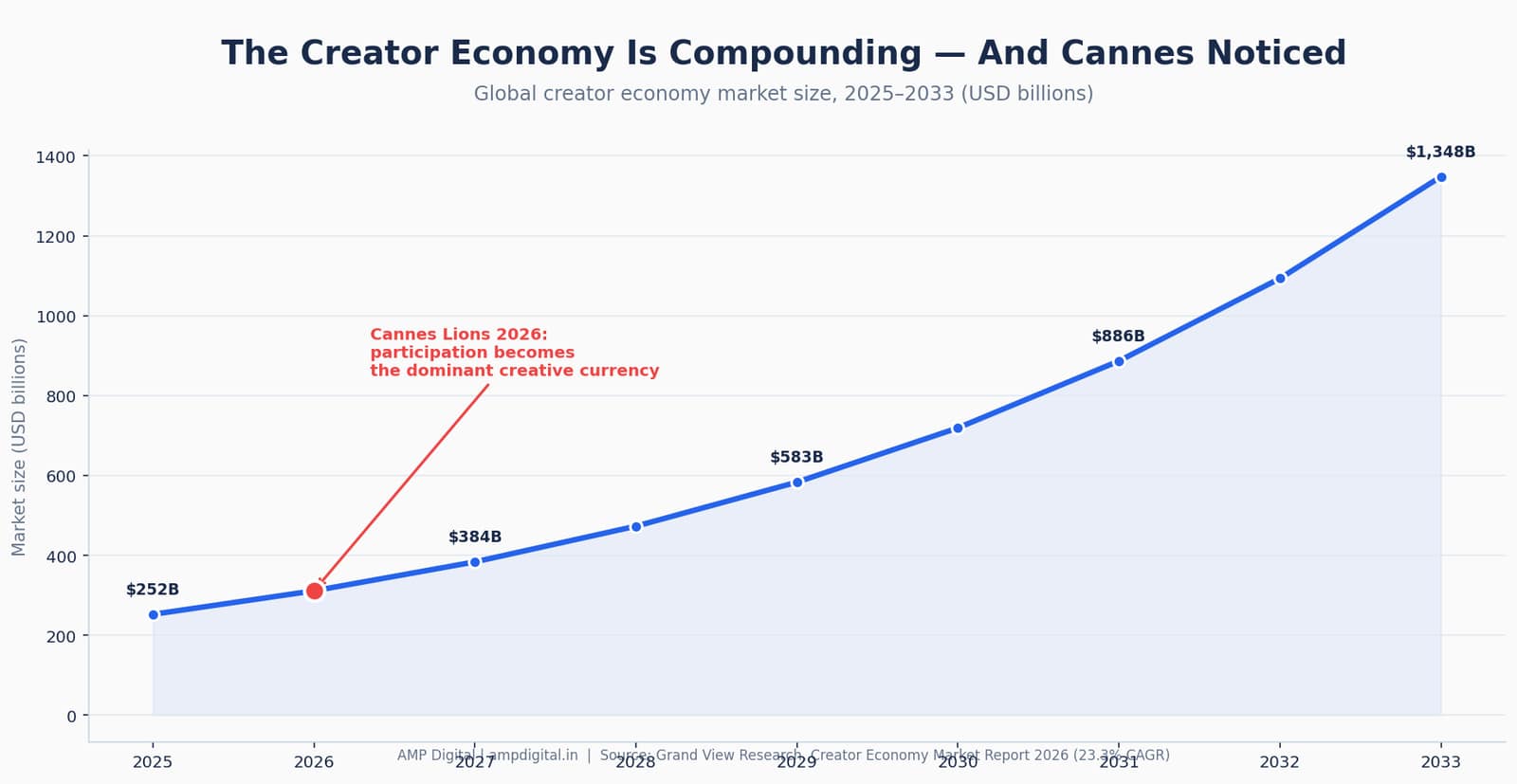
Jamie Gutfreund’s Forbes dispatch from the festival made the same point from the ground: this was the year the creator economy conversation moved from a fringe stage track to the main narrative of the entire festival, running alongside — and often ahead of — the traditional advertising conversation.
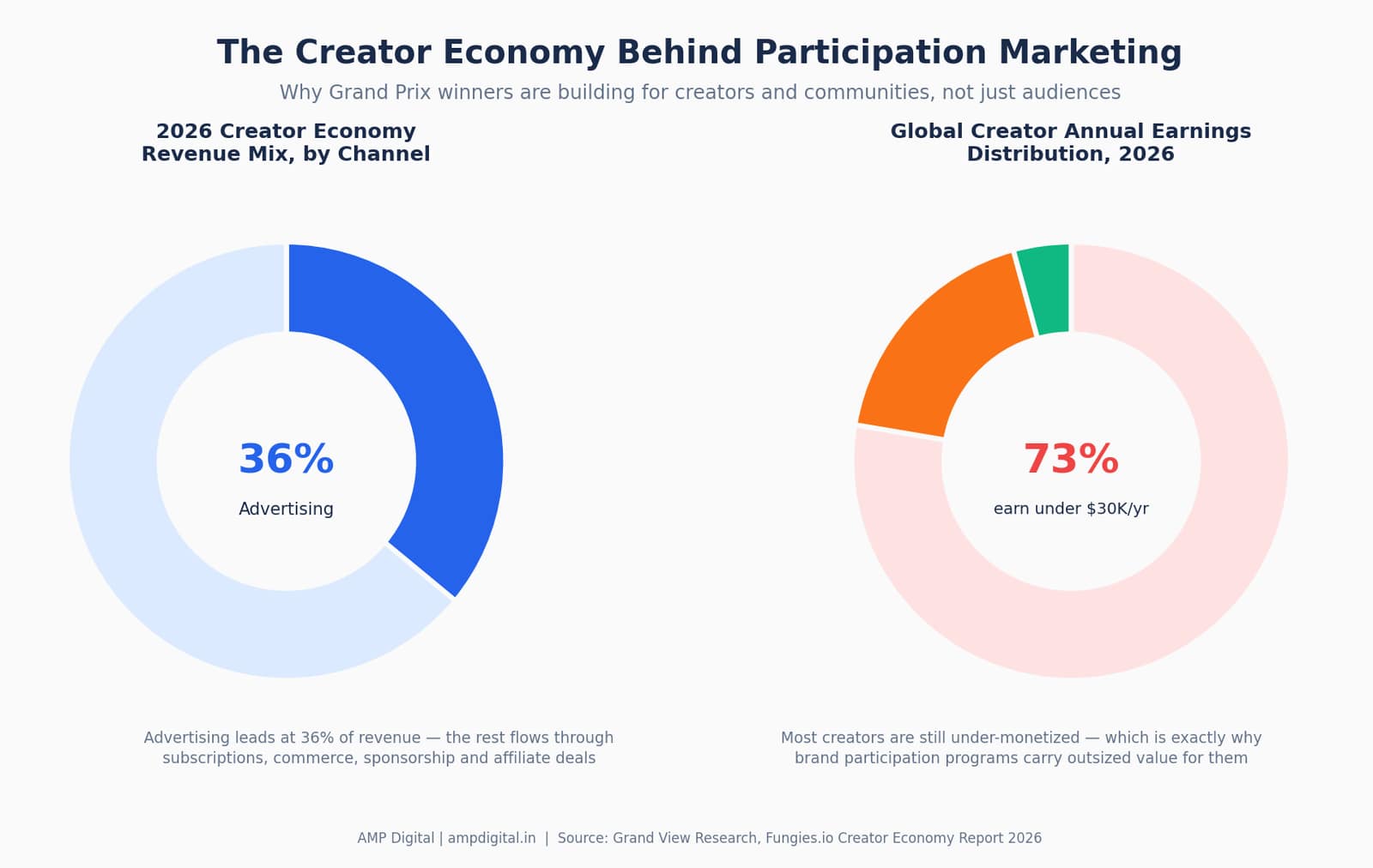
The earnings distribution matters for marketers specifically because it reframes what a "reward" needs to look like. Most creators are still under-monetized relative to their influence, which means a brand offering real credit, revenue share, or platform access is offering something scarcer — and more motivating — than a one-off content fee. That is precisely the mechanic behind Vaseline Originals, covered later in this article.
Lesson 1: Turn a Disruption Into a Collective Mystery
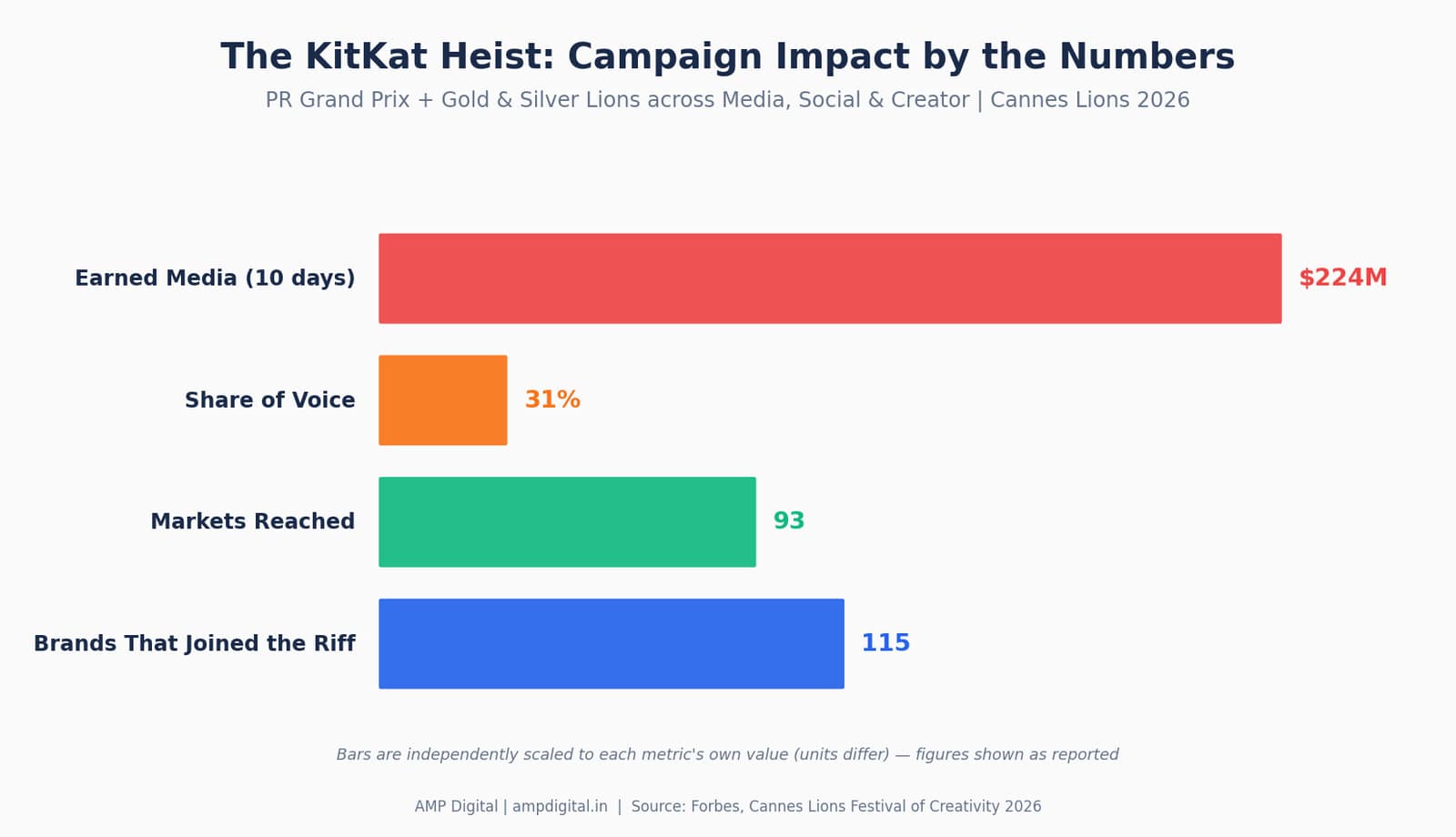
The single biggest PR win at Cannes Lions 2026 came from a campaign built almost entirely on absence. When KitKat’s signature red packaging and branding disappeared from shelves and social feeds without warning, the story briefly looked like a supply problem. It was, in fact, a staged "heist" designed by VML London and Burson — and it went on to win the PR Grand Prix, plus Gold and Silver Lions across Media, Social & Influencer, and Creator categories.
What made the KitKat Heist a participation campaign rather than a stunt was what happened after the initial disappearance: the brand did not explain itself. It let the internet investigate, theorize, and eventually solve the mystery collectively — and it invited other brands to play along inside the story rather than treating them as competitors for attention.
The Mechanics Other Brands Can Borrow
- Create a gap the internet has to fill. Leave a real gap, not a fake teaser. Audiences can tell the difference between a genuine mystery and a manufactured countdown clock. The KitKat campaign worked because the absence itself was disorienting enough to be worth investigating.
- Invite competitors and bystanders into the story. 115 other brands referenced, riffed on, or joined the KitKat storyline without being paid or briefed to do so. That only happens when a campaign is built as an open story rather than a closed message.
- Pay off the mystery visibly. A mystery with no resolution feels like a bug. KitKat’s eventual reveal paid off the investment audiences had made in solving it, which is what converted curiosity into 31% share of voice across 93 markets.
Pro Tip
You do not need a global FMCG budget to apply this lesson. B2B brands can run a smaller version by withholding a predictable content beat — a regular newsletter, a benchmark report, a product update — and letting the audience notice and ask before re-launching it with a twist. The mechanic is the gap, not the scale.
Lesson 2: Build Participation Into the Product, Not Just the Campaign
Not every participation lesson at Cannes Lions 2026 came from a single campaign. Some came from platforms whose entire business model is a demonstration of the principle. Twitch’s presence on the Cannes stage this year reinforced a point that ran through Jamie Gutfreund’s Forbes coverage of the festival: the brands and platforms winning attention are the ones where participation is not bolted onto content after the fact — it is the infrastructure the content runs on.
On Twitch, chat, emotes, subscriptions, and real-time reactions are not engagement features layered onto a video. They are the product. A stream without chat participation is a fundamentally different, less valuable experience than the same stream with an active chat — which is the opposite of how most brand content is still built, where comments and shares are an afterthought bolted onto a finished asset.
What "Infrastructure-Level Participation" Looks Like in Practice
- Real-time feedback loops are built in from the start: every layer of the experience assumes the audience will act, not just watch.
- Participation has a permanent home: the platform or campaign has a visible, standing mechanic for participation, not a one-time contest form.
- Contribution is visible to other participants: viewers, players, or readers can see other people participating in real time, which is what makes the loop self-reinforcing.
Approach | Participation as Campaign Layer | Participation as Infrastructure |
Where it lives | A microsite, hashtag, or contest form | The core product or content experience |
When it appears | During the campaign flight only | Permanently, independent of media spend |
What it optimizes for | Short-term entries or shares | Long-term community and repeat return visits |
For B2B and SaaS marketers, the translation is direct: a comment section, a user community, a customer-voted product roadmap, or a live Q&A series are not "nice to have" engagement add-ons. Built well and maintained consistently, they function the same way Twitch chat does — as the actual reason people show up a second time.
Lesson 3: Turn Community Contributions Into Real Equity
Vaseline Originals, created by Ogilvy Singapore, took home a Gold Lion plus Silver Lions across PR, Social & Influencer, Creator, and Creative B2B categories — and it did so by building a product line around a community that already existed rather than trying to manufacture a new one.
For years, people had been posting their own "hacks" for using plain Vaseline Jelly — as a lip gloss base, a highlighter, a skin-slugging treatment. Vaseline Originals turned that pre-existing, unpaid creative labor into an actual retail product line, credited the community whose hacks inspired it, and let the community keep shaping what came next.
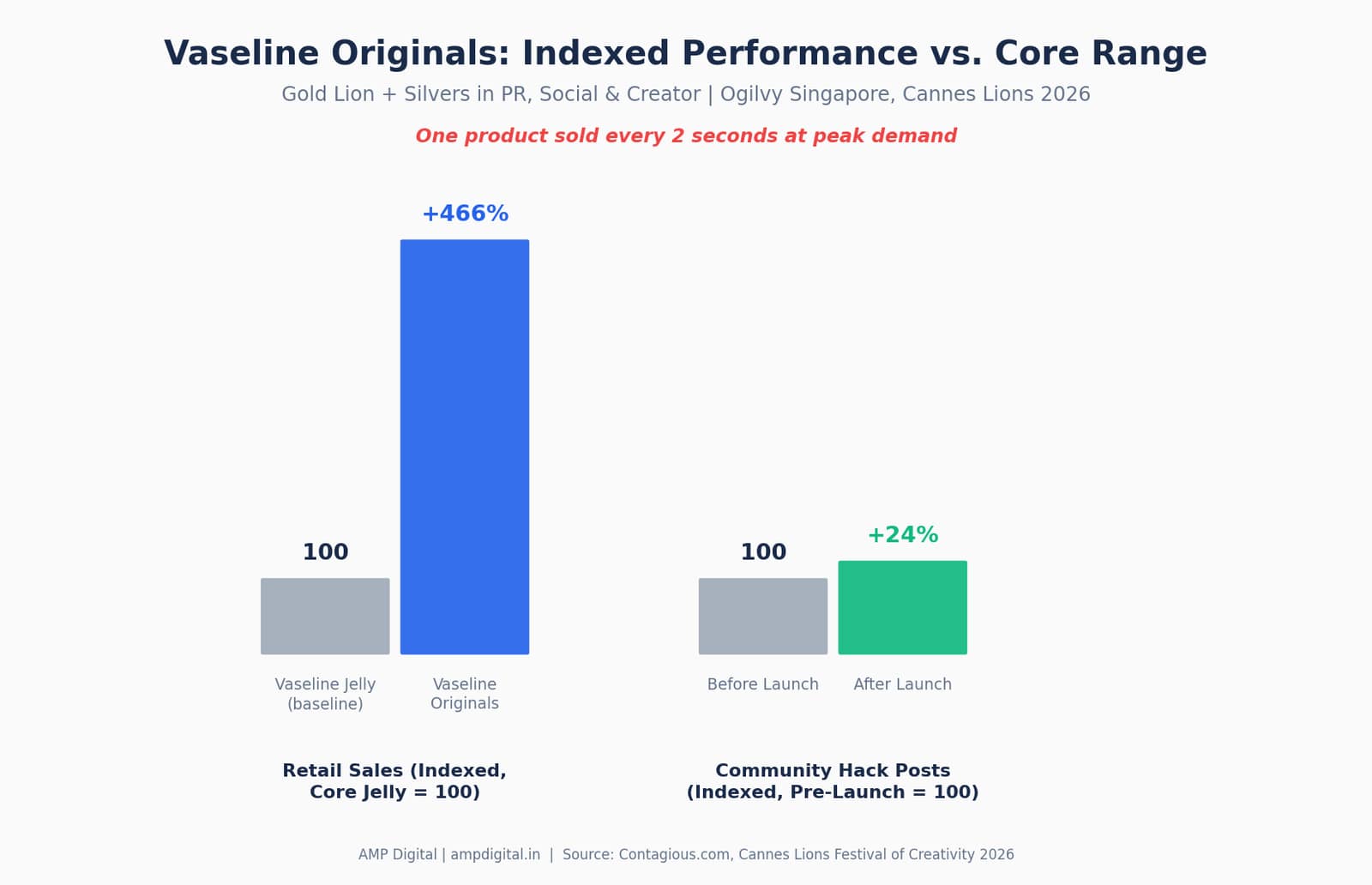
The results were not just creatively well-received — they were commercially decisive. Vaseline Originals outsold the core Vaseline Jelly range by 466%, with one unit sold every two seconds at peak demand. And the campaign kept compounding: after launch, the volume of community-posted "hacks" increased by 24%, meaning the campaign did not just monetize existing participation, it generated more of it.
The Equity Principle
- Credit the source publicly. Vaseline Originals openly credited the community hacks that inspired the range, rather than presenting the idea as an in-house innovation.
- Keep the loop open after launch. the product line stayed open to new community-submitted uses and formats after launch, rather than shipping once and moving on.
- Let recognition be the reward at scale. the 24% increase in hack posts after launch shows that being credited and productized is itself a reward that motivates further contribution, without a formal payment structure.
Key Stat
Vaseline Originals outsold the core Vaseline Jelly range by 466%, selling one unit every 2 seconds at peak demand, while community "hack" posts rose 24% after launch — proof that credited participation compounds rather than depletes.
The Participation Marketing Toolkit
Across the KitKat Heist, Vaseline Originals, Twitch, and NBA Take-Two Media (covered next), a consistent underlying loop emerges. It is worth naming explicitly, because it is the framework you can apply to a campaign brief regardless of category or budget.
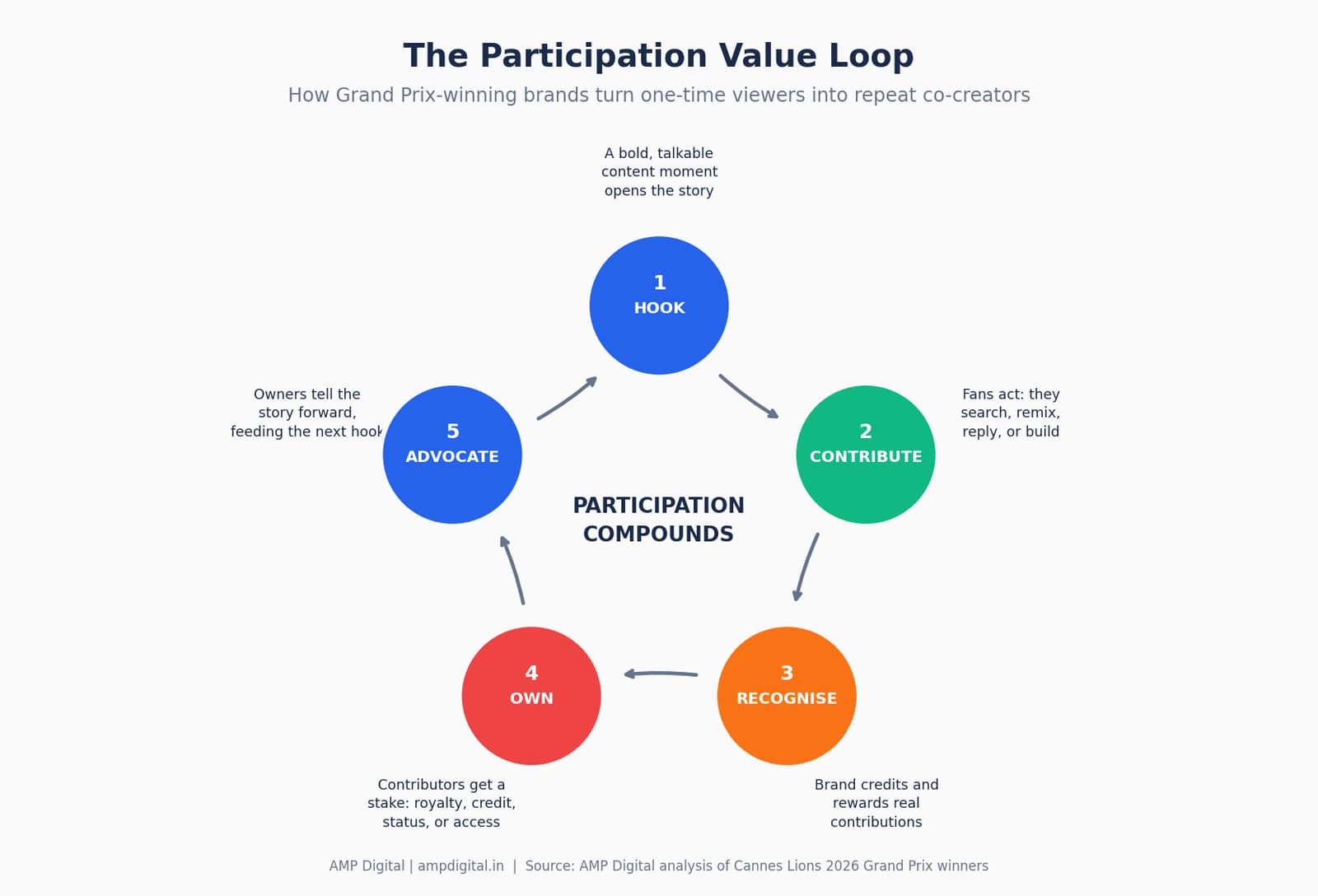
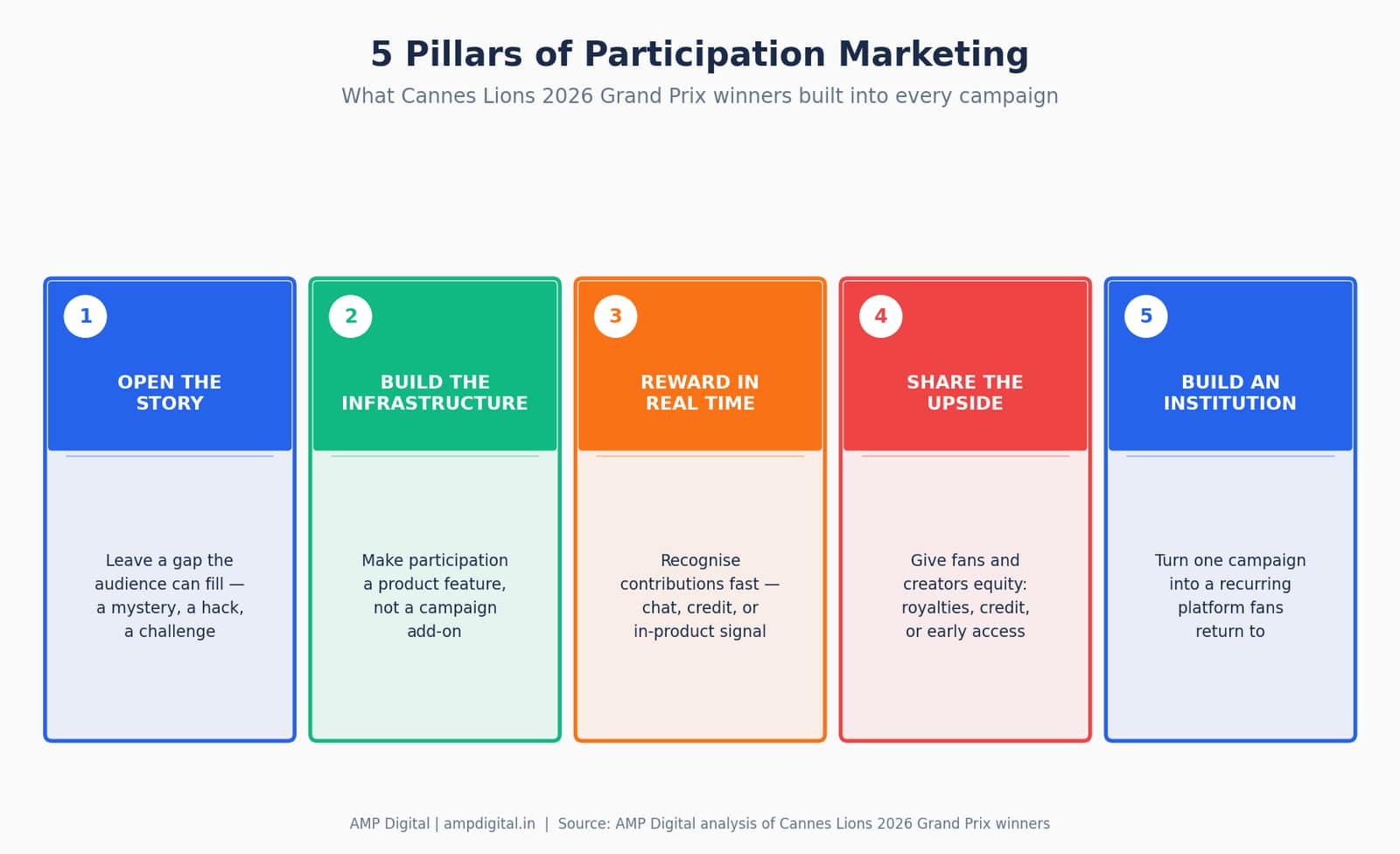
The five pillars below are the practical checklist version of that loop — the questions worth asking of any campaign brief before it ships.
Matching Mechanics to Funnel Stage
Funnel Stage | Mechanic | Example From This Article |
Awareness | Open mystery / gap in the story | KitKat Heist |
Consideration | Real-time, visible feedback loop | Twitch chat and streaming |
Conversion | Co-created product or offer | Vaseline Originals |
Retention | Recurring platform fans return to | NBA Take-Two Media |
Common Mistakes That Turn Participation Into a Gimmick
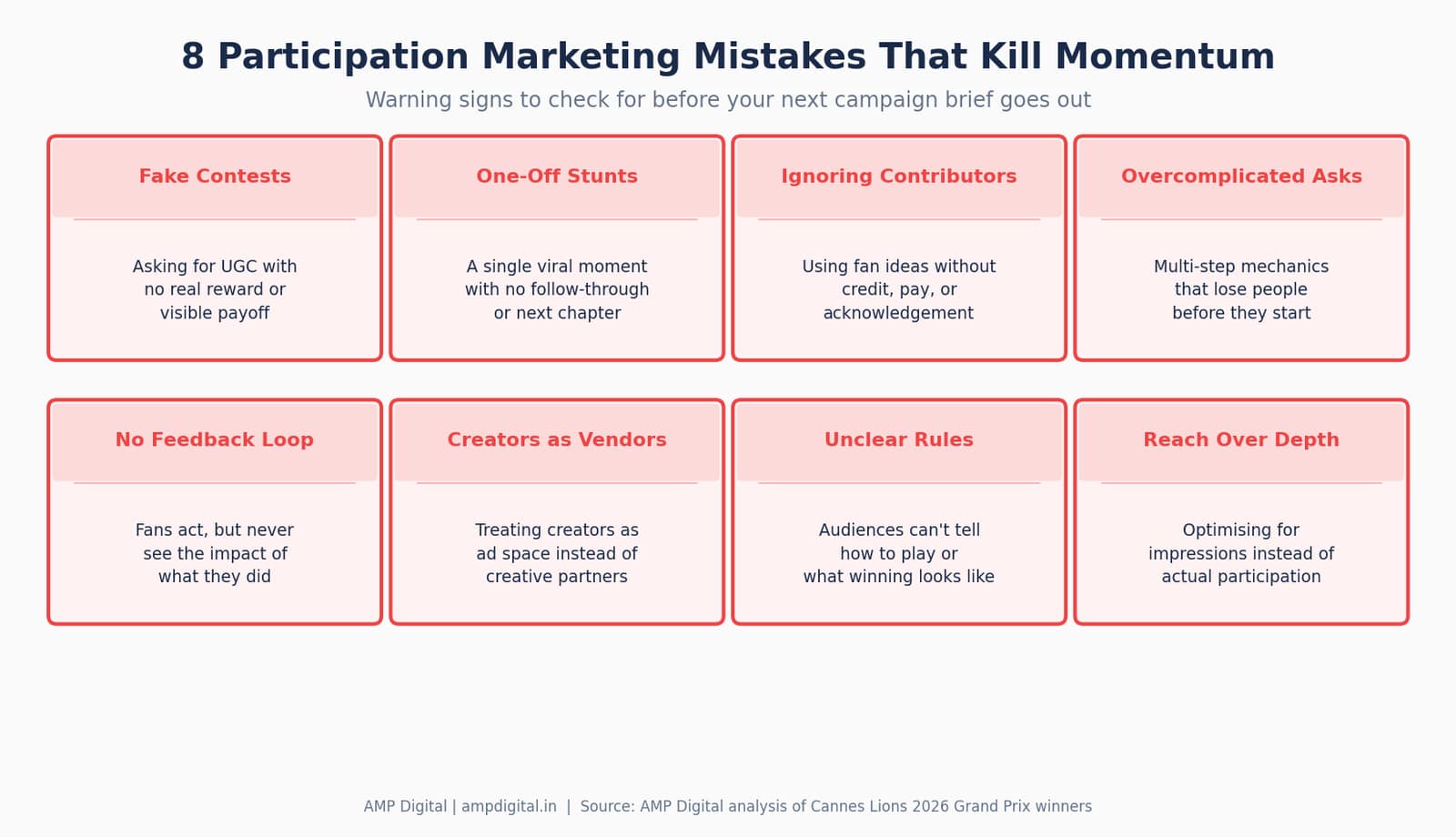
Not every brand that tries to copy this year’s Grand Prix winners will get the same result, and the difference is rarely budget. It is usually one of the following mistakes, all of which show up in campaigns that borrow the language of participation without the substance of it.
Warning
The most common failure mode is asking an audience to "participate" through a UGC contest with no real reward, no visible follow-through, and no credit for the people who show up. Vaseline Originals worked because contribution led to a real, credited, shelf-ready product — not because a hashtag existed.
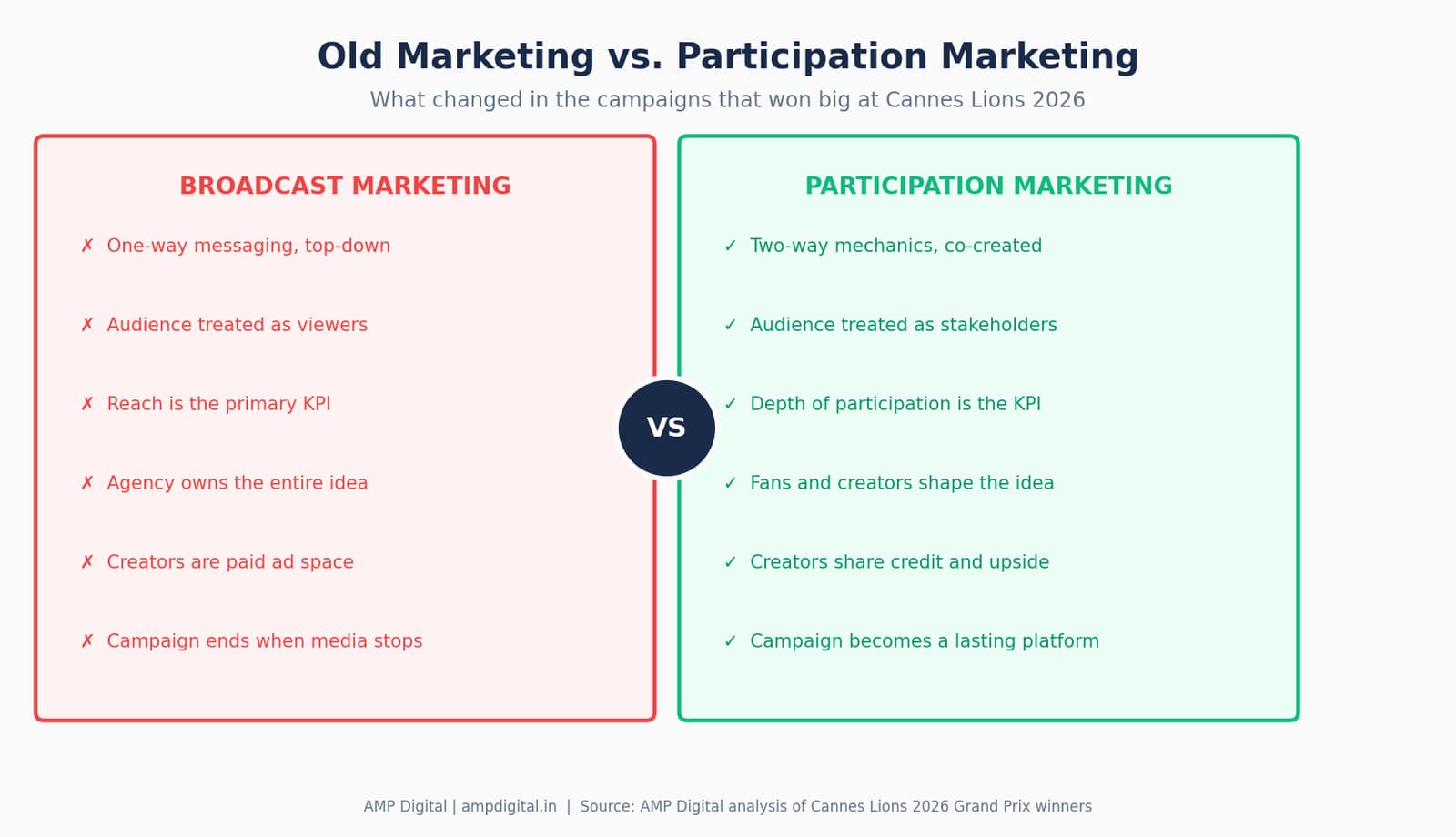
The comparison below summarizes the shift in mindset separating the campaigns that won Grand Prix honors this year from the ones that used similar tactics without the same results.
Lesson 4: Build a Media Institution Around Your Fans, Not Just a Campaign Around Your Product
The most structurally ambitious example from Cannes Lions 2026 was not a single campaign at all. NBA Take-Two Media, described on stage by Take-Two Interactive CEO Andrew Perlmutter, is a standing media operation built around NBA 2K players’ own content, not a marketing flight with a start and end date.
"Every basketball fan is a potential storyteller in this new model. We’re not just broadcasting games; we’re building the connective tissue for an entire ecosystem of content."
— Andrew Perlmutter, CEO, Take-Two Interactive
More than 110,000 NBA 2K players signed up to participate in the initiative — not as an audience for basketball content, but as its source. The comparison Perlmutter and others drew on stage was to MTV’s early role in the music industry: not a broadcaster of someone else’s content, but the connective institution that turned scattered fan and creator output into a coherent, recurring media brand.
Why This Is an "Advanced" Move, Not a Starting Point
Building an institution around participation is the hardest version of this playbook to execute, because it requires sustained investment rather than a single flighted campaign. It is worth attempting only after a brand has proven the smaller mechanics — the hook, the loop, the reward — work at a campaign level first. NBA Take-Two Media did not appear from nothing; it is the compounding result of years of NBA 2K community content that Take-Two chose to formalize and institutionalize rather than ignore.
Best Practice
Before building a permanent participation platform, run a smaller, time-boxed pilot. Identify where your audience is already creating content about you unprompted (reviews, tutorials, fan art, workarounds), then formalize and credit that existing behavior before trying to manufacture new behavior from scratch.
For B2B and enterprise brands, the equivalent is not a media network — it is a customer community, an alumni network of certified users, or a practitioner-run knowledge base that the brand supports rather than owns outright. The institutional logic is the same: give a fragmented but real audience a shared home, and let their output become the content engine.
More Grand Prix Winners That Prove the Pattern
The KitKat Heist, Vaseline Originals, and NBA Take-Two Media are the clearest illustrations of participation marketing at Cannes Lions 2026, but Contagious’s full round-up of the festival’s Grand Prix winners shows the same pattern recurring across categories that, on the surface, look unrelated.
Campaign | Category | The Participation Angle |
Apple TV rebrand | Design | Invited public reinterpretation of a familiar icon rather than a closed brand reveal |
Adidas Originals: Forever | Entertainment | Built an ongoing storytelling universe fans continue to contribute to |
Heineken: Could Have Been a Heineken | Social & Direct | Turned a common social mishap into a shareable, participatory in-joke |
The Pub That Refused to Die | Creative Strategy | Rallied a real community around saving a place they had a stake in |
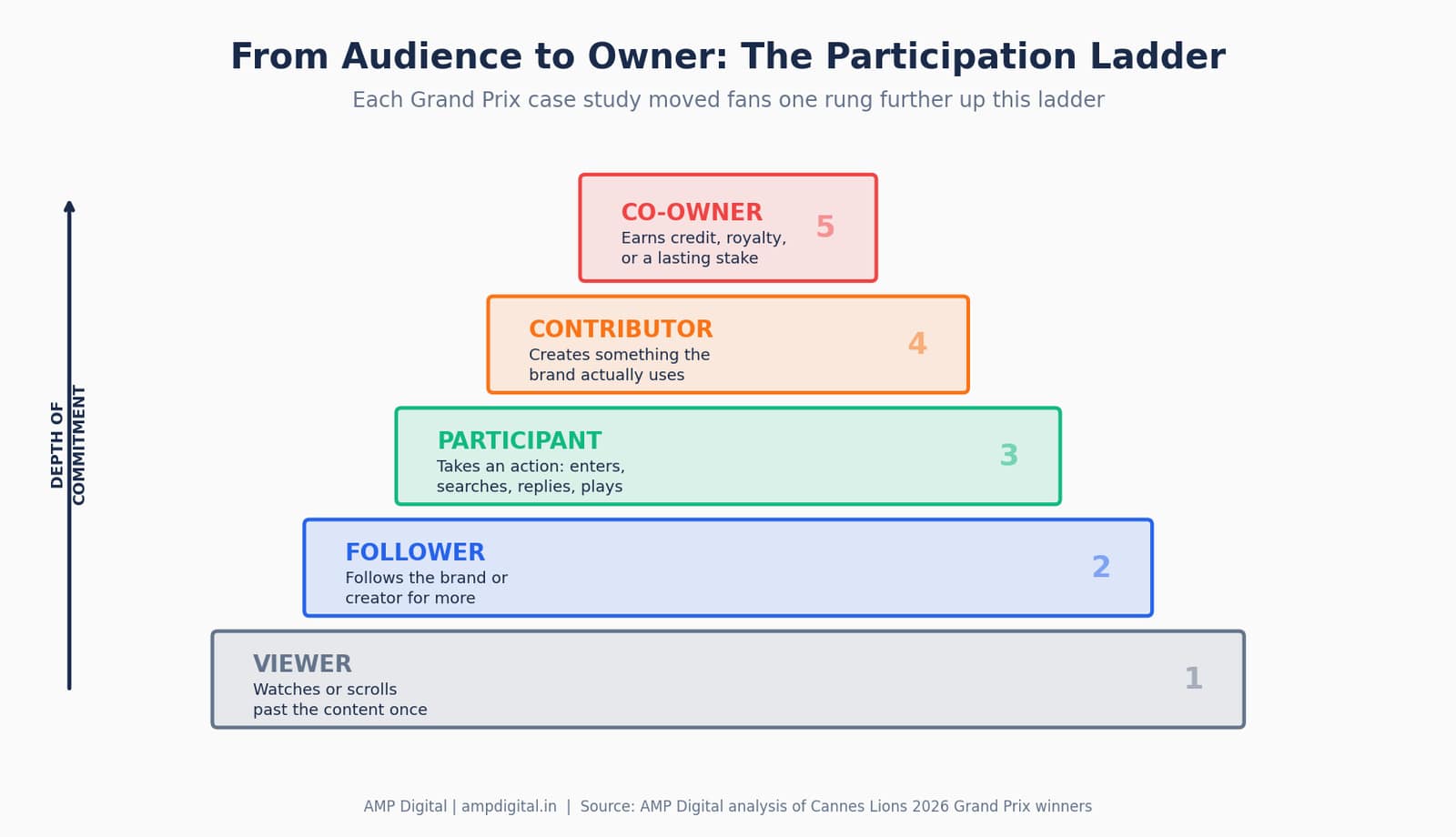
The ladder below shows the throughline connecting all of these examples: every one of them moved its audience at least one rung higher, from passive viewer toward some form of ownership over the outcome.
Where Participation Marketing Goes Next
Two forces are converging that will make the participation lessons from Cannes Lions 2026 more relevant in the next 24 months, not less.
First, the creator economy’s growth trajectory — projected to more than quintuple by 2033 — means the pool of people capable of producing brand-relevant content outside a formal agency relationship keeps expanding. Brands that have not built a mechanism for channeling that output will be competing with brands that have.
Second, AI-assisted content production is lowering the cost of producing content but not the cost of producing content people actually want to engage with. As raw content volume becomes cheaper and more abundant, the scarce resource shifts to genuine participation — verified human contribution, community trust, and credited co-creation — which is precisely what a generic AI-generated asset cannot fake. Expect the Cannes jury, and procurement briefs generally, to reward proof of real audience involvement over polish alone.
Building Your 6-Step Roadmap
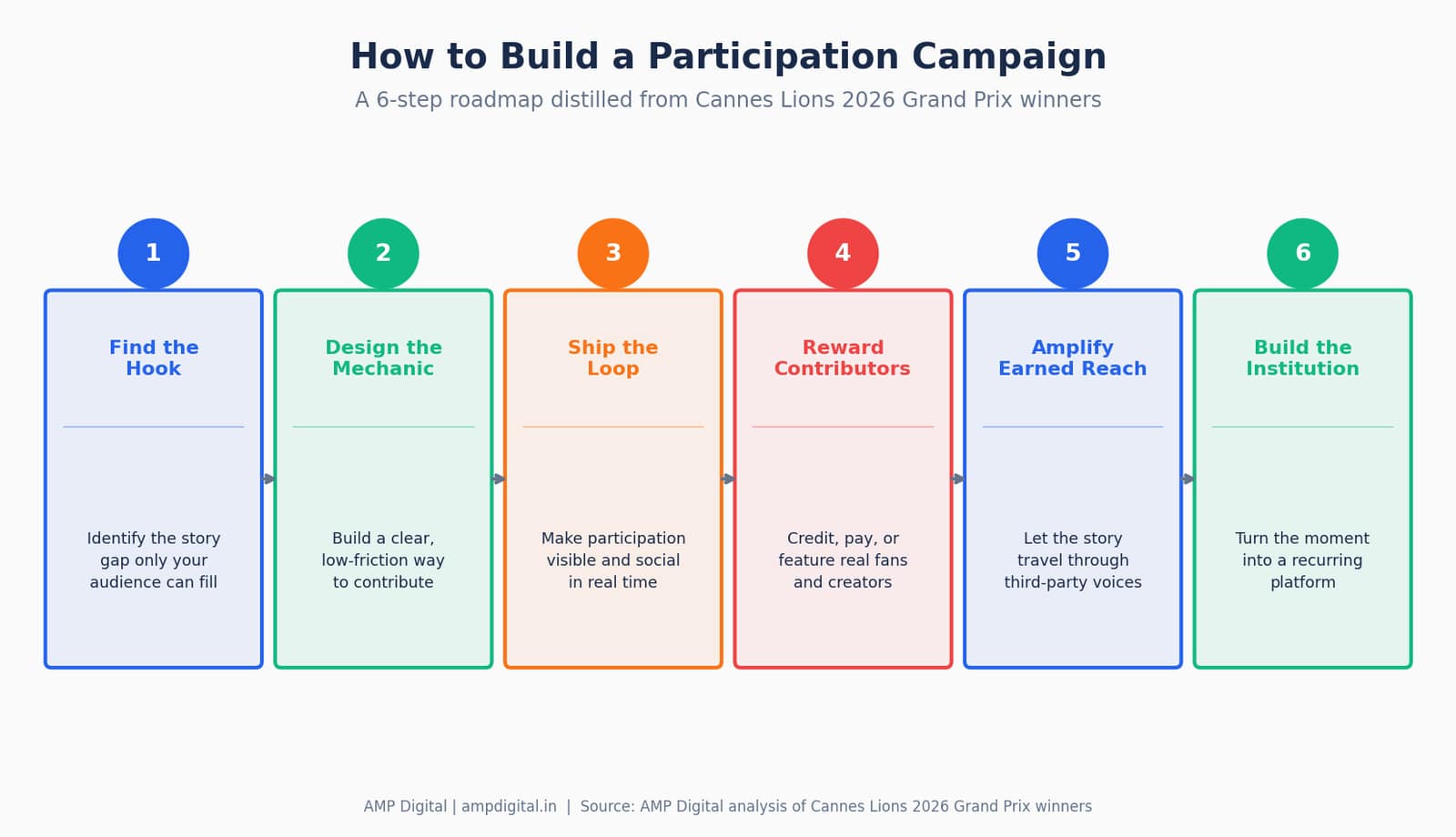
For teams ready to apply these lessons to their own content calendar, the following sequence mirrors how the winning Cannes Lions 2026 campaigns were actually built, from initial hook through to institutional platform.
Frequently Asked Questions
What is participation marketing?
Participation marketing is a strategy where the audience’s own contribution — ideas, content, creativity, or community activity — becomes a credited, visible part of the campaign itself, rather than the campaign simply being broadcast to a passive audience.
What won the Grand Prix at Cannes Lions 2026?
Cannes Lions 2026 Grand Prix and top honors spanned multiple campaigns, including the KitKat Heist (PR Grand Prix, plus Gold and Silver Lions in Media, Social & Influencer, and Creator) and Vaseline Originals (Gold Lion, plus Silvers in PR, Social & Influencer, Creator, and Creative B2B), alongside wins for Apple’s TV rebrand, Adidas Originals: Forever, and other campaigns covered in Contagious’s full 2026 round-up.
How is participation marketing different from influencer marketing?
Influencer marketing typically pays a known creator to produce content on a brand’s behalf. Participation marketing is broader: it invites an unpaid, often anonymous audience or community to contribute directly, and credits or rewards that contribution as part of the campaign’s core mechanic, as seen in Vaseline Originals’ use of community-submitted product hacks.
Does participation marketing work for B2B brands?
Yes, though the mechanics look different from consumer campaigns. B2B equivalents include customer advisory boards, practitioner communities, co-created benchmark reports, and user-voted product roadmaps — all of which apply the same underlying principle of giving the audience real, credited input rather than treating them as a passive readership.
What is the biggest risk in trying to copy these campaigns?
The most common failure is running a shallow version of participation — a UGC contest or hashtag campaign with no genuine reward, follow-through, or credit for contributors. This produces content volume without the trust or advocacy that made the Cannes Lions 2026 winners work.
How big is the creator economy in 2026?
The global creator economy is estimated at roughly $252 billion in 2025, growing at a 23.3% compound annual growth rate toward a projected $1.3 trillion-plus by 2033, according to Grand View Research’s Creator Economy Market Report.
Conclusion: The Content Gets Them In — Participation Is What Compounds
The clearest signal from Cannes Lions 2026 is that the industry’s highest creative honors are no longer going to campaigns that simply capture attention well. They are going to campaigns and platforms that convert attention into a role the audience actually plays — whether that is solving a mystery, submitting a hack that becomes a product, chatting in real time, or telling their own story inside a brand’s ecosystem.
None of the four lessons in this article require a Cannes-sized budget to apply. They require a willingness to leave room in a campaign for someone else’s contribution, and the discipline to credit and reward that contribution when it shows up.
Summary
Four lessons from Cannes Lions 2026: (1) Turn a disruption into a collective mystery the audience solves together, like the KitKat Heist. (2) Build participation into your product’s infrastructure, not just a campaign layer, like Twitch. (3) Turn community contributions into real, credited equity, like Vaseline Originals. (4) Once the smaller mechanics work, build a lasting institution around your most engaged fans, like NBA Take-Two Media.
References
- Contagious. "Cannes Lions 2026: The Grand Prix-winning campaigns." contagious.com, 2026.
- Gutfreund, Jamie. "Cannes Lions 2026: It Was Hot. The Creator Economy Was Hotter." Forbes, June 28, 2026.
- Grand View Research. "Creator Economy Market Size, Share & Growth Report, 2025–2033."
- Fungies.io. "Creator Economy Report 2026: Revenue Channels and Earnings Distribution."