
If you’ve spent any time looking at your analytics lately, you’ve probably noticed something strange. Traditional search traffic is behaving differently. If you're still focusing all your energy on securing the "number one spot" on a page of blue links, you’re essentially using a 2022 map to navigate a 2026 landscape.
The biggest shift we’ve seen this year isn't just a new algorithm update. It's a complete change in how people find information. We’ve moved from the era of Search Engine Optimization (SEO) into the age of Generative Engine Optimization (GEO).
What is GEO and Why Does it Matter?
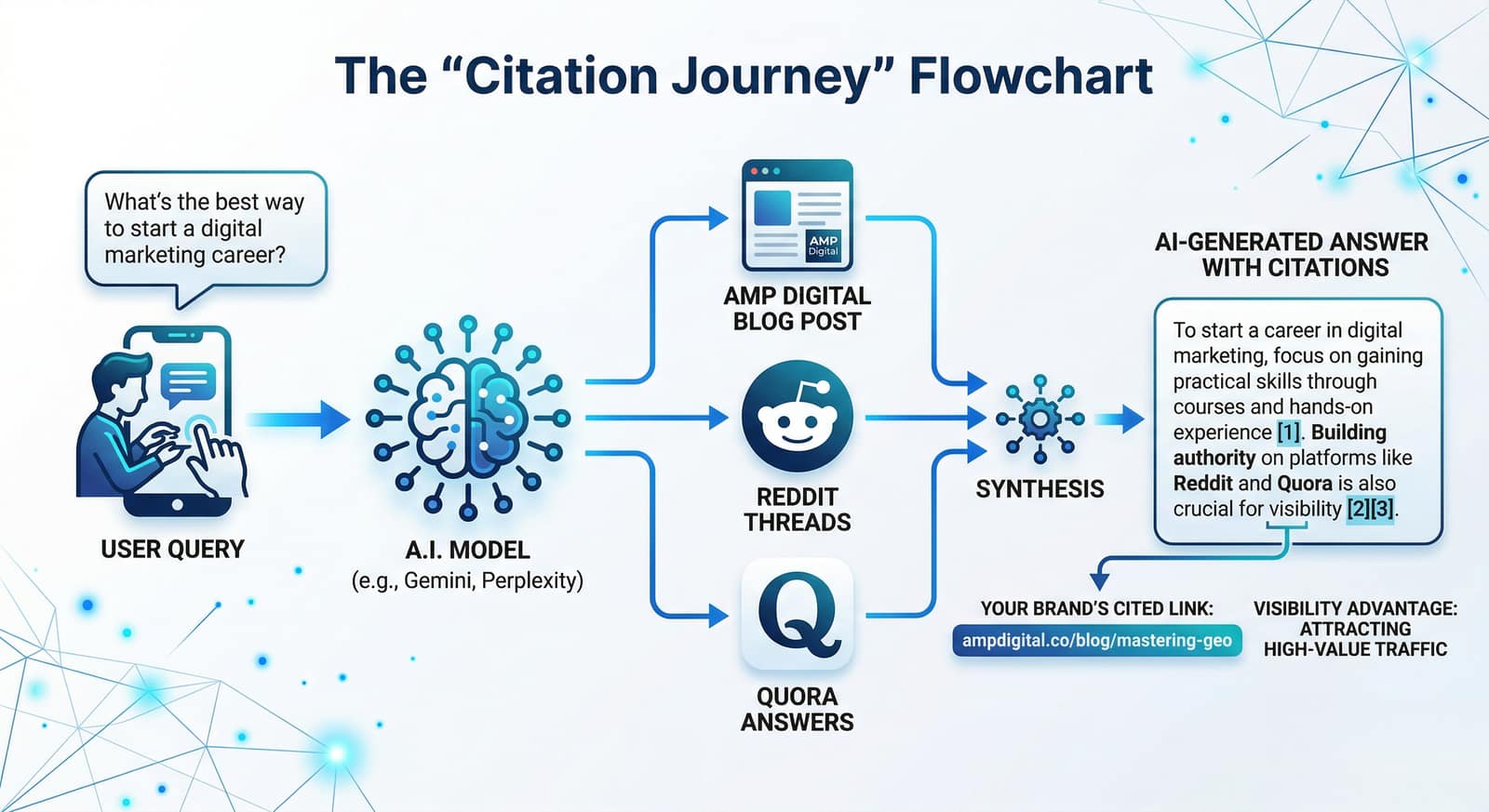
Generative Engine Optimization is the practice of making your brand the primary source for AI models like Gemini, SearchGPT, and Perplexity. In 2026, users often skip the search results page entirely. They ask a question, and the AI provides a synthesized answer.
Your goal as a marketer has shifted. It’s no longer about getting a click; it’s about becoming the citation. When an AI summarizes an answer, it cites its sources. If your website is the one being quoted, you gain a level of authority that a simple ranking can’t provide. This is a core module in any modern Digital Marketing Course, as it represents the most significant pivot in organic strategy in over a decade.
The Reddit and Quora "Authority" Pivot
One of the most interesting trends discussed on Reddit and Twitter right now is where these AI models get their "truth." AI systems are heavily weighted toward human-centric platforms. When someone asks an AI for a product recommendation or a complex "how-to," the model often scans subreddits, Quora threads, and community forums to see what real people are saying.
To stay relevant, your brand needs to exist beyond your own website. You need a presence in the places where conversations happen. This "Entity Authority" is built through consistent, helpful participation in niche communities. AI models see these mentions and begin to associate your brand with specific expertise.
3 Ways to Optimize for AI Citations
How do you actually "do" GEO? It requires a different technical and creative approach than traditional SEO.
1. Focus on "Fan-Out" Queries
When a user asks a complex question, AI models break it down into smaller sub-queries, known as "fan-out" queries. For example, if someone asks, "What is the best way to start a career in marketing in 2026?", the AI might search for "entry-level marketing skills," "marketing salary trends," and "top-rated courses." Your content should provide direct, clear answers to these specific sub-questions to increase your chances of being cited.
2. Structure for Extraction
AI models prefer content that is easy to parse. This means using clear heading hierarchies (H1, H2, H3), bulleted lists, and "answer-first" paragraphs. Start your sections with a direct answer to a common question, then follow up with the context. If an AI can easily extract a snippet of your text to answer a user's prompt, you win the citation.
3. The E-E-A-T Powerhouse
Experience, Expertise, Authoritativeness, and Trustworthiness (E-E-A-T) are more important now than ever. With AI-generated content flooding the web, search engines and generative models are desperate for human-led insights. Sharing original data, case studies, and personal experiences makes your content "uncopyable" by basic AI bots, marking you as a high-value source for citations.
Bridging the 2026 Skills Gap
The speed of this transition has left many professionals feeling behind. The tactics that worked eighteen months ago are becoming obsolete. We are seeing a massive demand for marketers who understand the technical side of LLMs, the psychology of conversational search, and the ability to manage brand reputation across fragmented platforms.
Learning these high-level strategies is the best way to future-proof your career. If you want to dive deeper into these shifts, enrolling in AMP Digital's comprehensive Digital Marketing Course can give you the hands-on experience needed to master GEO and AI-driven strategy.
Is Traditional SEO Dead?
Not exactly, but it has evolved. Think of SEO as the foundation and GEO as the structure built on top of it. You still need a fast website, clean code, and quality backlinks. However, those are now the "entry stakes." The real competition is happening in the "Answer Engines."
Success in 2026 requires a hybrid approach. You need to keep your technical SEO sharp while simultaneously building the kind of brand authority that AI models can't ignore. This balance is exactly what we focus on in our updated Digital Marketing Course syllabus.
Moving Forward
The transition to GEO is an opportunity to move away from "keyword stuffing" and back toward genuine, helpful content. By focusing on being the most authoritative and cite-worthy source in your niche, you ensure that your brand stays visible, no matter how the search interface changes.

👉 [CLICK HERE] Enroll in the 2026 Digital Marketing Training Program
If you’re ready to transition from a traditional marketer to a 2026-ready strategist, joining our Digital Marketing Course is your next logical step. The landscape is changing fast—make sure you have the right tools to lead the way.
Mastering these new engines is about more than just traffic. It's about owning the conversation in an AI-first world. Whether you're refining your current strategy or starting from scratch with AMP Digital's Digital Marketing Course, the goal remains the same: provide the best answer, in the clearest format, on the platforms that matter most.