
TL;DR
- Learn what the California SB 942 & EU AI rules are
- These acts requires content creators to label any AI generated content
- However, this could lead to over labeling and users may not trust this as much
- So creators need to balance this intelligently.
Disclosure Fatigue vs. Digital Trust: What California and EU AI Rules Mean for Creators
I. Introduction
A brand deal lands in your inbox: a hero product shot, a voiceover, and a background plate, all buildable with generative tools before lunch. Two years ago, that was a workflow flex. As of August 2026, it is also a compliance event.
Generative AI has moved from novelty feature to everyday fixture in content workflows. Quick image cleanup, AI-assisted voiceover, fully synthetic background plates, and, increasingly, entire synthetic personas built for a single campaign now sit alongside a phone camera and a laptop as standard creator tools.
That shift has run straight into a regulatory one. California's AI Transparency Act (SB 942) became operative on August 2, 2026, after an amendment pushed its original January 2026 start date back to align with a second, larger deadline: the same day, the EU AI Act's Article 50 transparency obligations became applicable across the European Union. For the first time, two major jurisdictions' AI content-disclosure mandates are enforceable on the identical calendar date, and platform policies from YouTube, TikTok, and Meta already sit on top of both.
That creates a genuine paradox. Audiences say, overwhelmingly, that they want AI-generated content labeled, but the same audiences are showing signs of switching off when disclosure becomes wallpaper: a badge, banner, or disclaimer repeated so often it stops registering as information and starts reading as noise, or worse, as a reason to distrust everything else on the page too.
“authenticity has stopped being a default assumption”
- DesignRush, "7 Brands Using ‘No AI’ Disclaimers to Win Consumer Trust," 2026
This piece works through what SB 942 and EU AI Act Article 50 actually require, why heavy-handed disclosure risks the exact trust it's meant to protect, and how creators and brands can treat transparency as a competitive differentiator rather than a legal chore bolted onto a content calendar after the fact. It closes with a practical checklist for auditing your own content pipeline against both frameworks.
II. The Legal Landscape: What Rules Apply to Content Creators?
Two statutes now govern how creators disclose AI use, and a fast-growing set of platform policies sit on top of both.
1. California SB 942 (AI Transparency Act)
Governor Newsom signed SB 942 on September 19, 2024. AB 853, signed October 13, 2025, amended the law and pushed its operative date from January 1, 2026 to August 2, 2026, deliberately aligned with the EU AI Act's own enforcement date. The law applies to “covered providers”: entities that create, code, or otherwise produce a generative AI system with more than one million monthly visitors or users, publicly accessible in California.
- Visible (Manifest) Disclosures: Covered providers must offer a free, publicly available detection tool, and provide users the option to add a clear, durable visible badge to AI-generated media.
- Embedded (Latent) Provenance: Content must carry C2PA-compatible, machine-readable metadata: a manifest recording creation timestamps and model credentials that survives even when the visible badge doesn't.
AB 853 also layered on a new obligation for “large online platforms” (social networks, general-purpose search engines, mass-messaging platforms): beginning January 1, 2027, these platforms must detect C2PA-compatible provenance data in distributed content and disclose it to users, for example, surfacing an “AI-generated” indicator when a watermarked image appears in a feed.
2. EU AI Act (Article 50)
Article 50 transparency obligations became applicable across the EU on August 2, 2026. The European Commission published draft guidelines on May 8, 2026, and the Code of Practice on Transparency of AI-generated Content, the voluntary but Commission-endorsed compliance route, was finalized on June 10, 2026; roughly 190 organizations had signed it by the end of July 2026.
- Deepfake & Synthetic Media Marking: Providers generating synthetic audio, image, video, or text must mark outputs in a machine-readable format and ensure they are detectable as AI-generated or manipulated (Article 50(2)). Deployers publishing deepfakes must disclose that content has been artificially generated or manipulated (Article 50(4)); critically, this duty applies even where there was no intent to deceive and even when no real individual is depicted.
- Public Interest Text & AI Interactions: Synthetic text published on matters of public interest must be labeled unless it has undergone meaningful human editorial review. Chatbots and virtual assistants must identify themselves as AI to any user interacting with them.
Penalties reach €15 million or 3% of worldwide turnover. A pending AI Omnibus proposal, on which the European Parliament and Council reached political agreement, would give the specific Article 50(2) marking and detection obligations transitional relief; the Council has floated a revised deadline of December 2, 2026 for that narrower piece, though formal adoption was still pending as of this writing. The deepfake and public-interest labeling duties under Article 50(4) are not part of that proposed delay.
3. Platform & App Store Fallouts
Major platforms have built their own disclosure layers directly into posting flows, independent of, but increasingly cross-referencing, SB 942 and Article 50.
- YouTube: requires an “altered or synthetic content” disclosure toggle in Studio for qualifying uploads, backed by a three-strike inauthentic-content policy (warning, 90-day suspension, then permanent removal from the Partner Program).
- TikTok: launched creator-side AIGC labeling in September 2023 and became, in May 2024, the first video platform to implement C2PA Content Credentials detection: content carrying C2PA provenance from tools like DALL-E or Adobe Firefly is labeled automatically on upload.
- Meta: unified its Instagram and Facebook AI policies in February 2026, requiring an in-post “AI Info” label distinct from caption text. Instagram began piloting an optional account-level “AI creator” badge in May 2026.
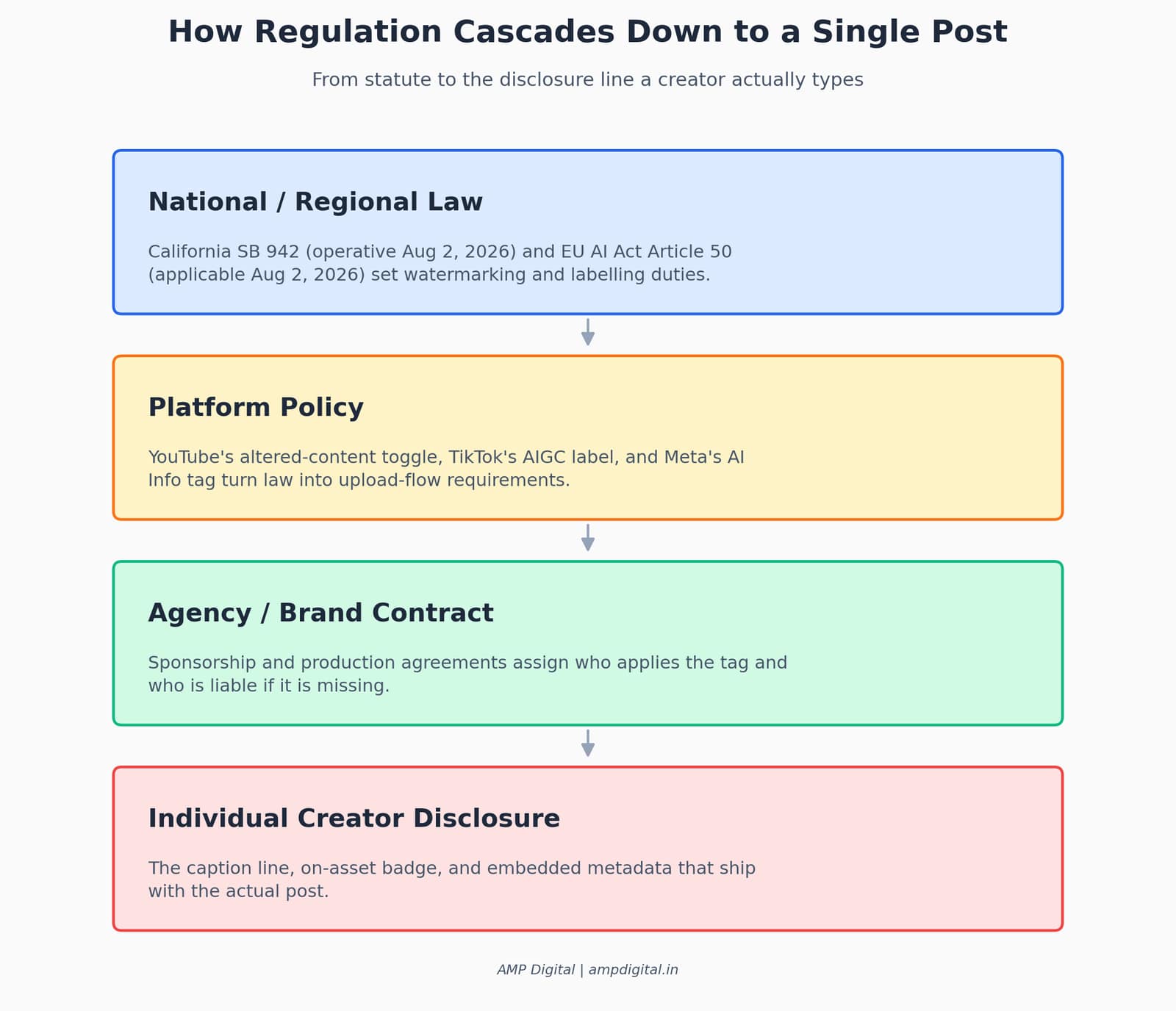
How a single piece of legislation cascades down to the disclosure line a creator actually types.
Framework | Applies To | Core Requirement | Effective Date |
|---|---|---|---|
CA SB 942 (as amended by AB 853) | Covered GenAI providers, >1M CA users | Visible + latent (C2PA) disclosure, free detection tool | Aug 2, 2026 |
EU AI Act, Article 50(2) | Providers of synthetic-content systems | Machine-readable marking, detectable output | Aug 2, 2026 (grace period to Dec 2026 pending) |
EU AI Act, Article 50(4) | Deployers publishing deepfakes | Clear deepfake labeling, even without deceptive intent | Aug 2, 2026 |
CA SB 942, platform duty | Large online platforms | Detect + surface C2PA provenance to users | Jan 1, 2027 |
YouTube policy | Creators, monetized + organic | Altered/synthetic content toggle | Live; 3-strike enforcement |
TikTok policy | Creators + advertisers | AIGC label + automatic C2PA detection | Live since 2023 / 2024 |
Meta policy | Creators + advertisers | In-post “AI Info” label | Unified Feb 2026 |
KEY STAT
August 2, 2026 marks the first time California and the EU are both actively enforcing AI content-disclosure law on the same calendar date, a convergence AB 853’s own drafting history says was deliberate.
“When in doubt, disclose.”
- TikTok Policy Team, via AuditSocials, “TikTok AI Content Policy 2026,” 2026
III. The Risk: Understanding "Disclosure Fatigue"
Disclosure fatigue is what happens when a legally correct label stops functioning as a signal: viewers have seen it so often it fades into background noise, or breeds outright suspicion instead of trust.
The data already shows both halves of that dynamic in motion. Consumer use of AI for search rose sharply through 2026: 70% of U.S. consumers say their AI search use increased over the past year, but perceived helpfulness fell at the same time, and the share who rate AI search as less helpful than traditional search grew sixfold.
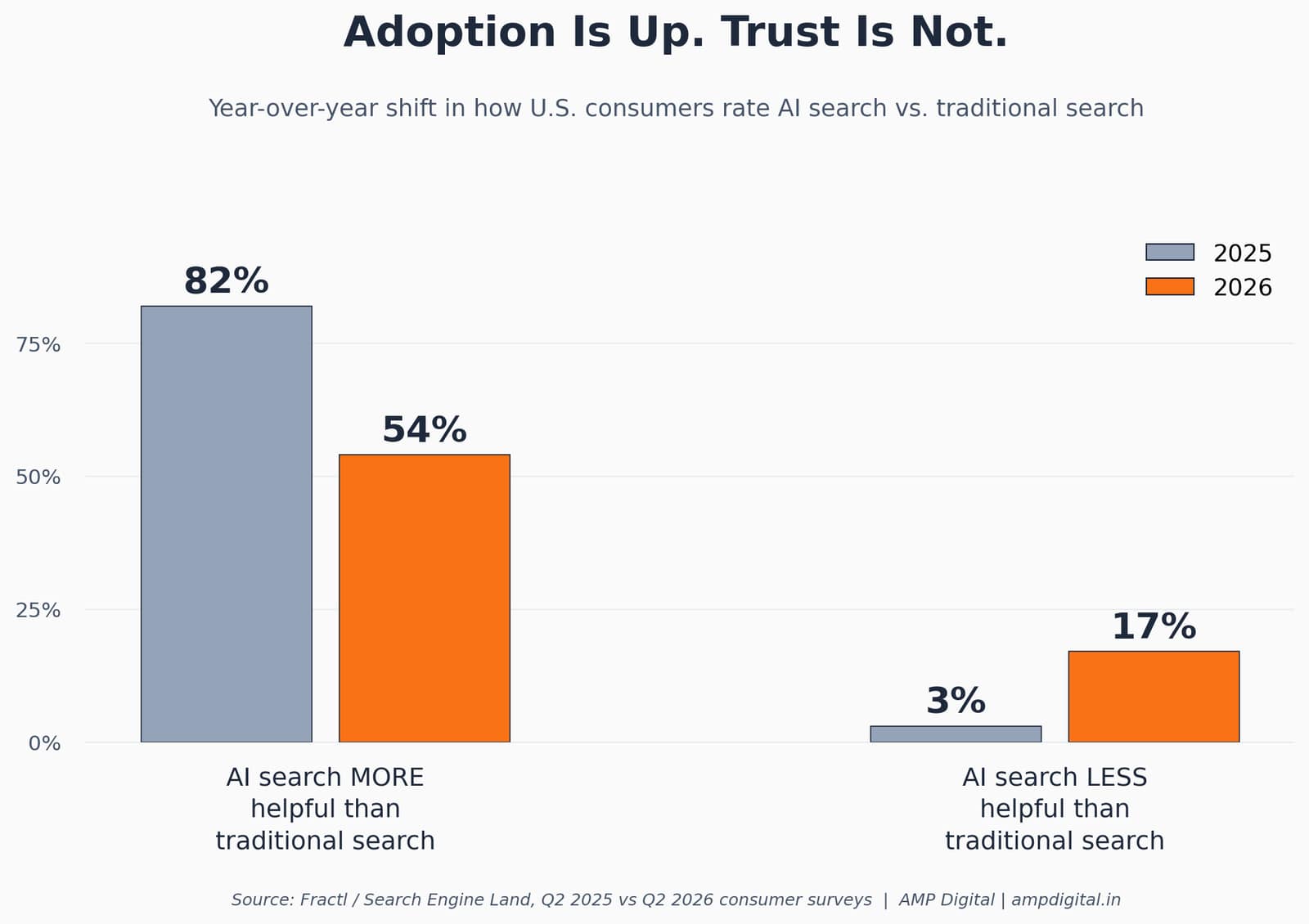
Adoption and trust are no longer moving in the same direction.
“People are using a tool they trust less, more”
- Digital Applied, summarizing Fractl / Search Engine Land Q2 2026 survey findings
The Spectrum of AI Use
Not every AI touch carries the same disclosure weight, and treating them identically is precisely what drives fatigue.
AI Use Tier | Examples | Typical Disclosure Expectation |
|---|---|---|
Light Retouching / Editing | Noise reduction, background removal, colour balancing | Generally exempt as assistive editing |
Synthetic Assistance | Script ideation, voice synthesis, background fills | Contextual: a visible cue is recommended |
Fully AI-Generated | Synthetic avatars, deepfakes, digital personas | Mandatory manifest + latent disclosure |
The UX & Creative Strains
Heavy-handed watermarking: a large logo burned into every frame, a repeated pop-up banner on every scroll stop, disrupts the aesthetic flow creators are paid to deliver, and audiences notice the disruption before they read the disclosure itself. The strain compounds because skepticism isn't staying contained to the labeled content: a 2025 Gartner survey of 1,539 U.S. consumers found 68% frequently wonder whether the content and information they see online is genuine at all, meaning fatigue with one brand's AI labels can bleed into distrust of an entire feed.
WARNING: Fatigue Compounds, It Doesn’t Stay Contained The share of consumers who say a brand’s heavy AI use would decrease their trust in that brand nearly doubled, from 20% in 2025 to roughly 39% in 2026. Among Gen Z, that figure reaches 54%; among women, 44% versus 34% of men. |
IV. The Solution: Turning Transparency into Digital Trust
The fix isn't less disclosure; it's disclosure designed with the same intent as the creative work it sits on top of.
1. Adopt Layered Disclosures
Front-End (User Level): a subtle, elegant visual cue: an unobtrusive corner icon, a single consistent caption line, that doesn't break the creative frame it's attached to.
Back-End (Technical Level): embedded C2PA metadata that carries model credentials and edit history for search engines, web crawlers, and ad platforms to read, even when the visible badge is cropped out or the file is reshared.
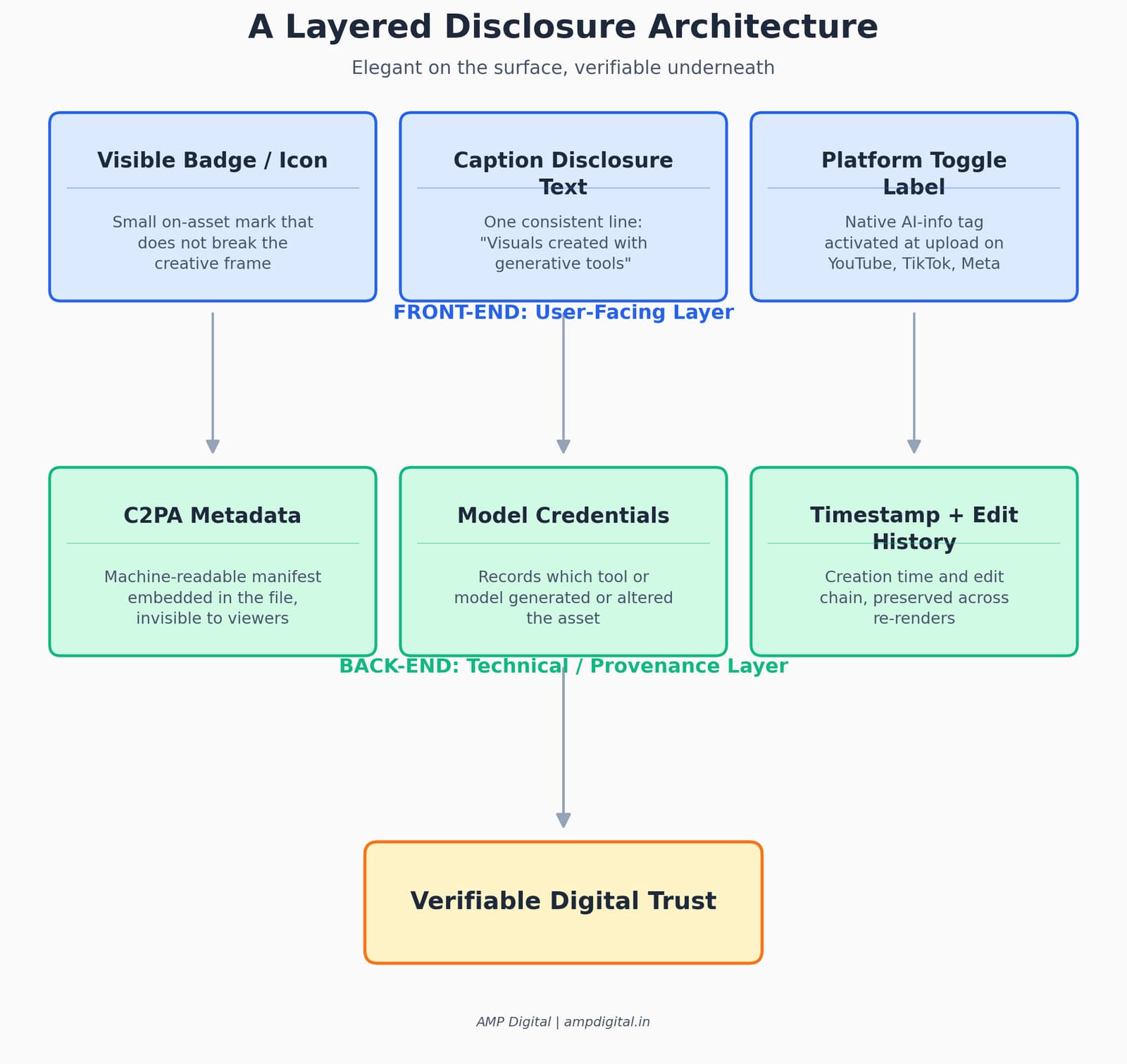
Elegant on the surface, verifiable underneath: front-end and back-end disclosure working together.
“a nutrition label for digital media”
- TextSight, "C2PA Content Credentials 2026 - What They Are and How to Verify," 2026
2. Human-in-the-Loop Branding
Highlighting the human editorial oversight, storytelling, and creative direction behind a piece differentiates it from automated, low-quality spam, and gives audiences a positive reason to trust the work, rather than just a compliance mark to tolerate. As of January 2026, the Content Authenticity Initiative counted more than 6,000 members spanning technology companies, camera makers, newsrooms, and creative professionals actively using Content Credentials in production specifically to attribute work back to its human creator.
3. Proactive Creator Disclosure Policies
Publishing a clear “AI Ethics Statement” on a creator portfolio or agency site sets expectations before a regulatory body or platform forces the issue. It converts a legal minimum into a public, ongoing brand signal.
PRO TIP: A Caption Line That Does the Job Standardize one sentence and reuse it verbatim across posts: "Visuals created with generative tools; storyline by [Creator]." Consistency itself becomes a trust signal; audiences learn to recognize the phrasing rather than parse a new disclaimer every time. |
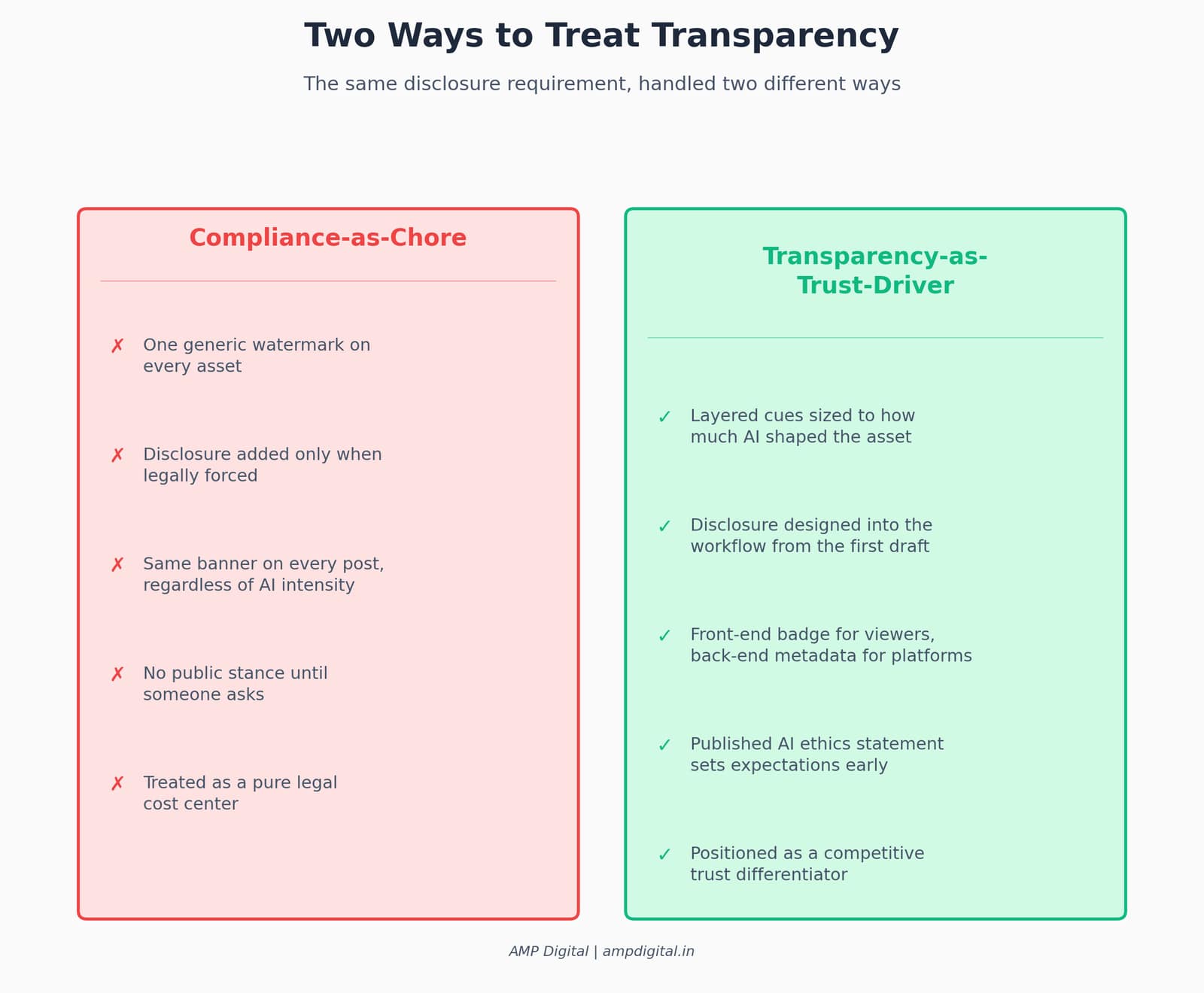
The same disclosure requirement, handled two different ways.
V. Practical Checklist for Creators and Brands
Four steps translate both frameworks into a repeatable production habit rather than a one-time scramble.
- Audit Creative Tooling: Ensure the tools in active use, Photoshop, Midjourney, ElevenLabs, and similar, support standard C2PA provenance metadata by default.
- Standardize Caption Disclosures: Implement repeatable, clear wording in social post captions (e.g., “Visuals created with generative tools; storyline by [Creator].”).
- Review Contractual Obligations: Update agency, sponsor, and brand-partner agreements to define who is responsible for applying AI tags on sponsored posts.
- Preserve Metadata Across Channels: Avoid re-rendering or compression tools that accidentally strip latent watermarks from source files before publishing.
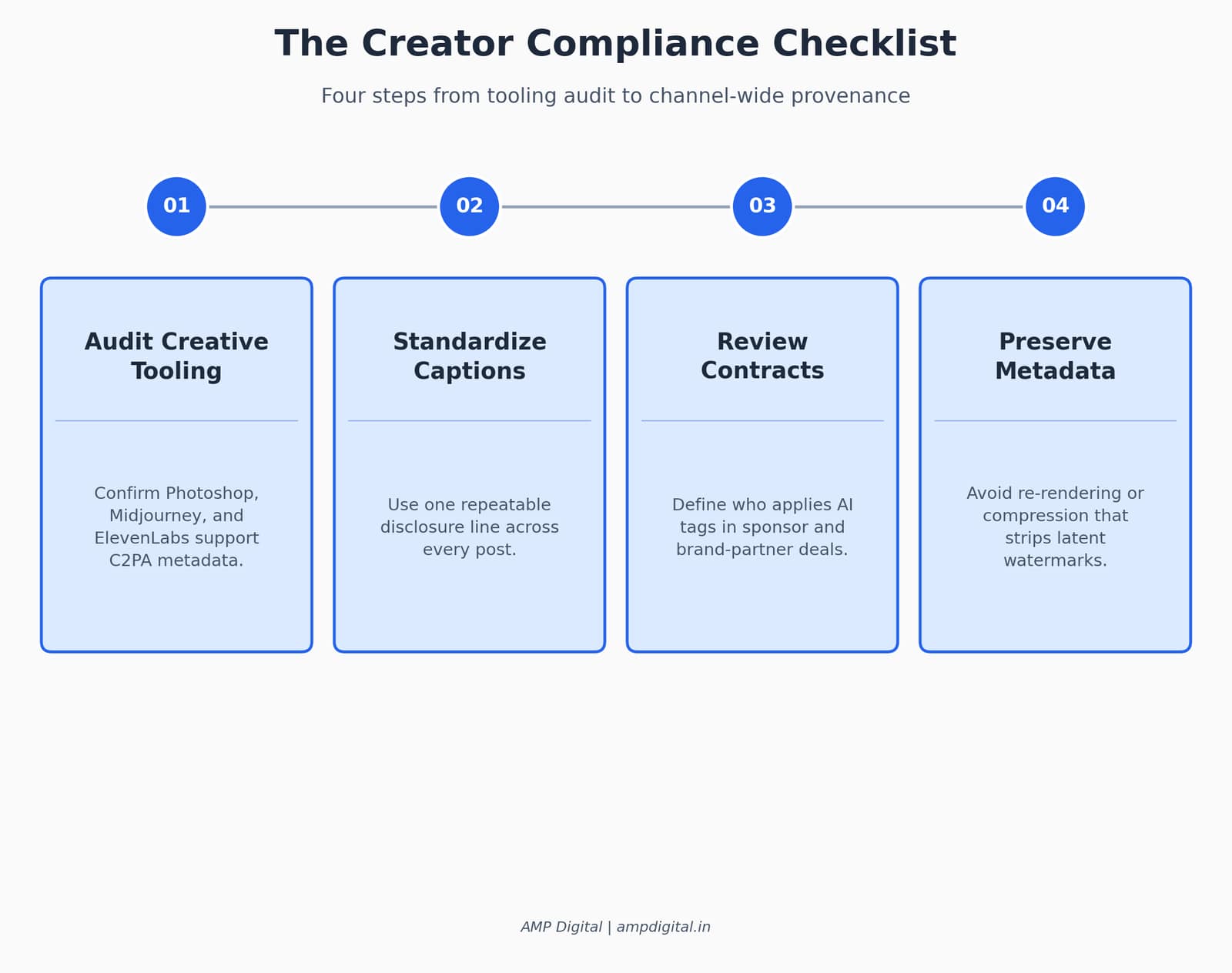
Four steps from tooling audit to channel-wide provenance.
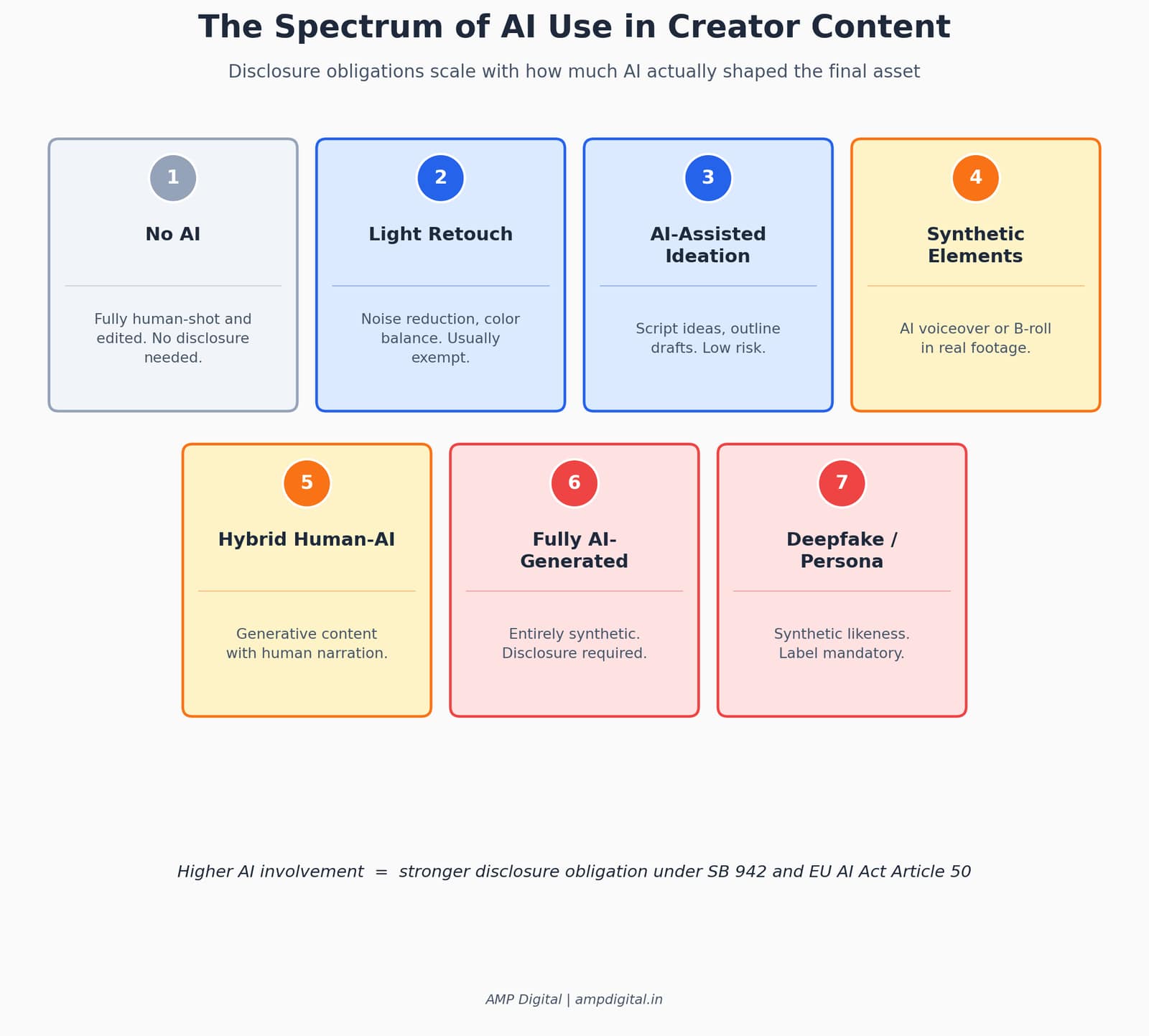
Matching disclosure intensity to how much AI actually shaped the final asset.
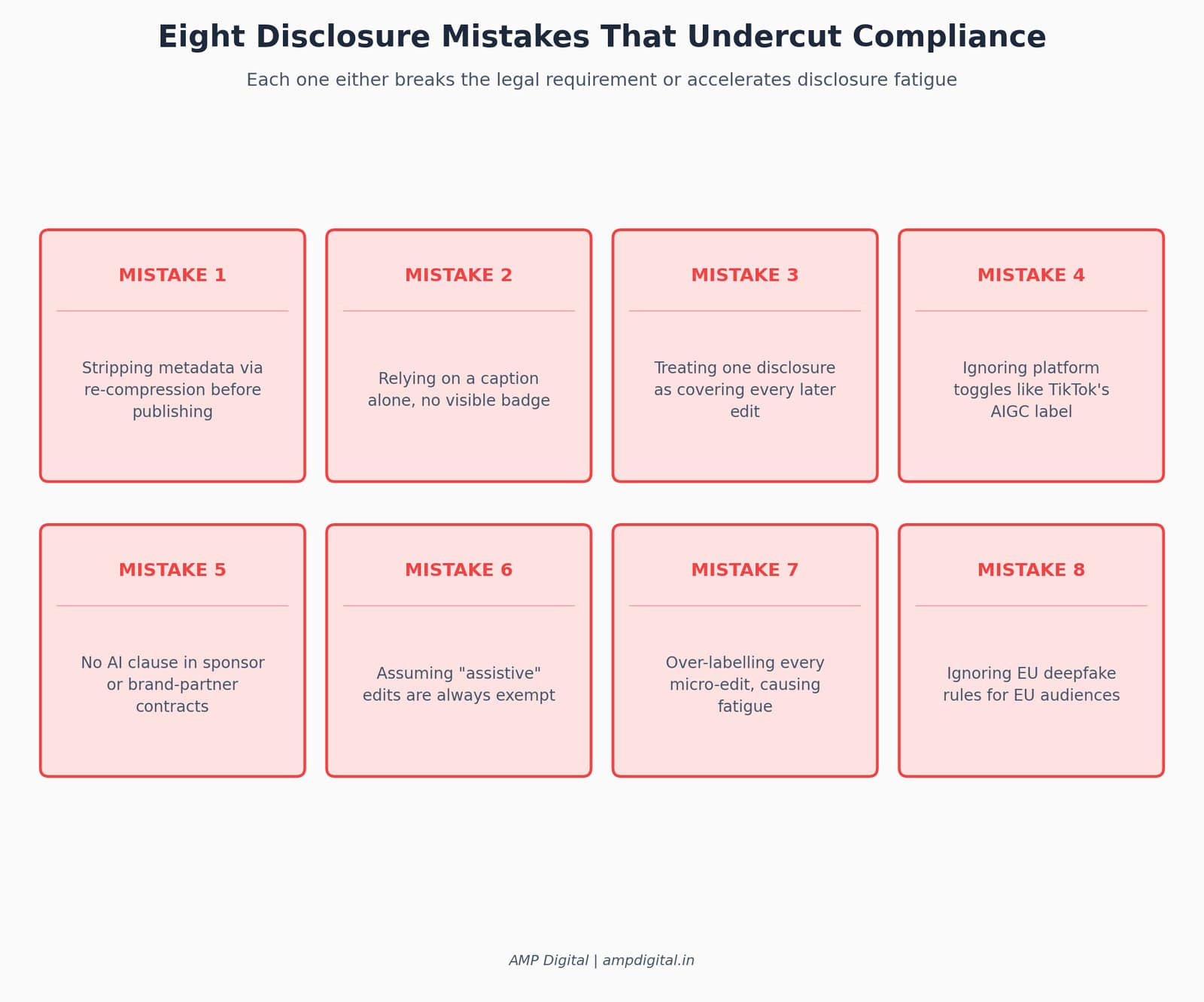
The most common ways a well-intentioned disclosure workflow still fails.
VI. Conclusion
Transparency requirements aren't disappearing: SB 942 and EU AI Act Article 50 both went live on August 2, 2026, and platform policy is closing whatever gaps remain. Creators and brands who treat disclosure as thoughtful, non-intrusive design rather than a bolted-on legal chore will avoid regulatory penalties while building the deeper audience trust that heavy-handed, undifferentiated labeling actively erodes.
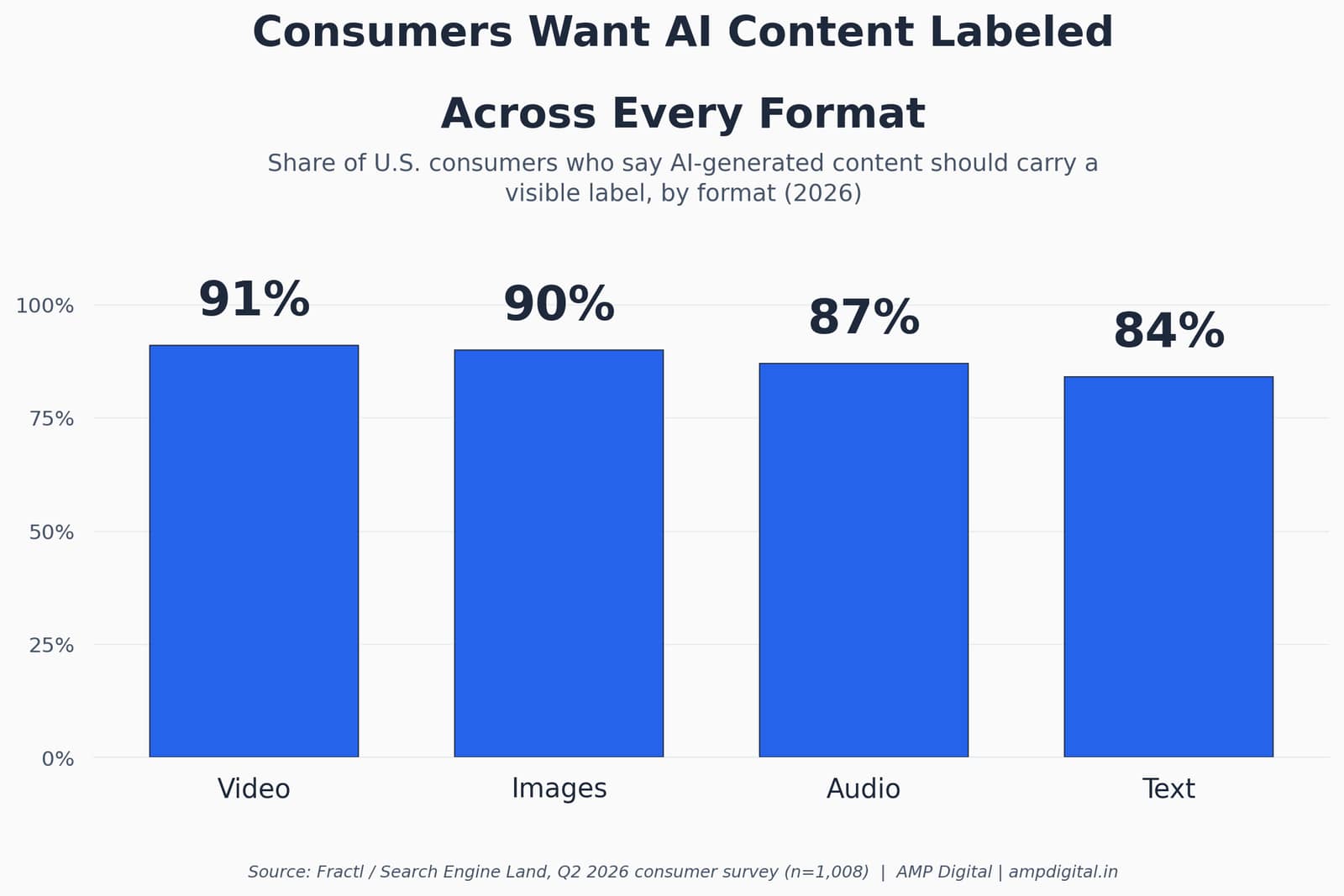
The demand for labeling isn’t going away; the way brands meet it is what will differentiate them.
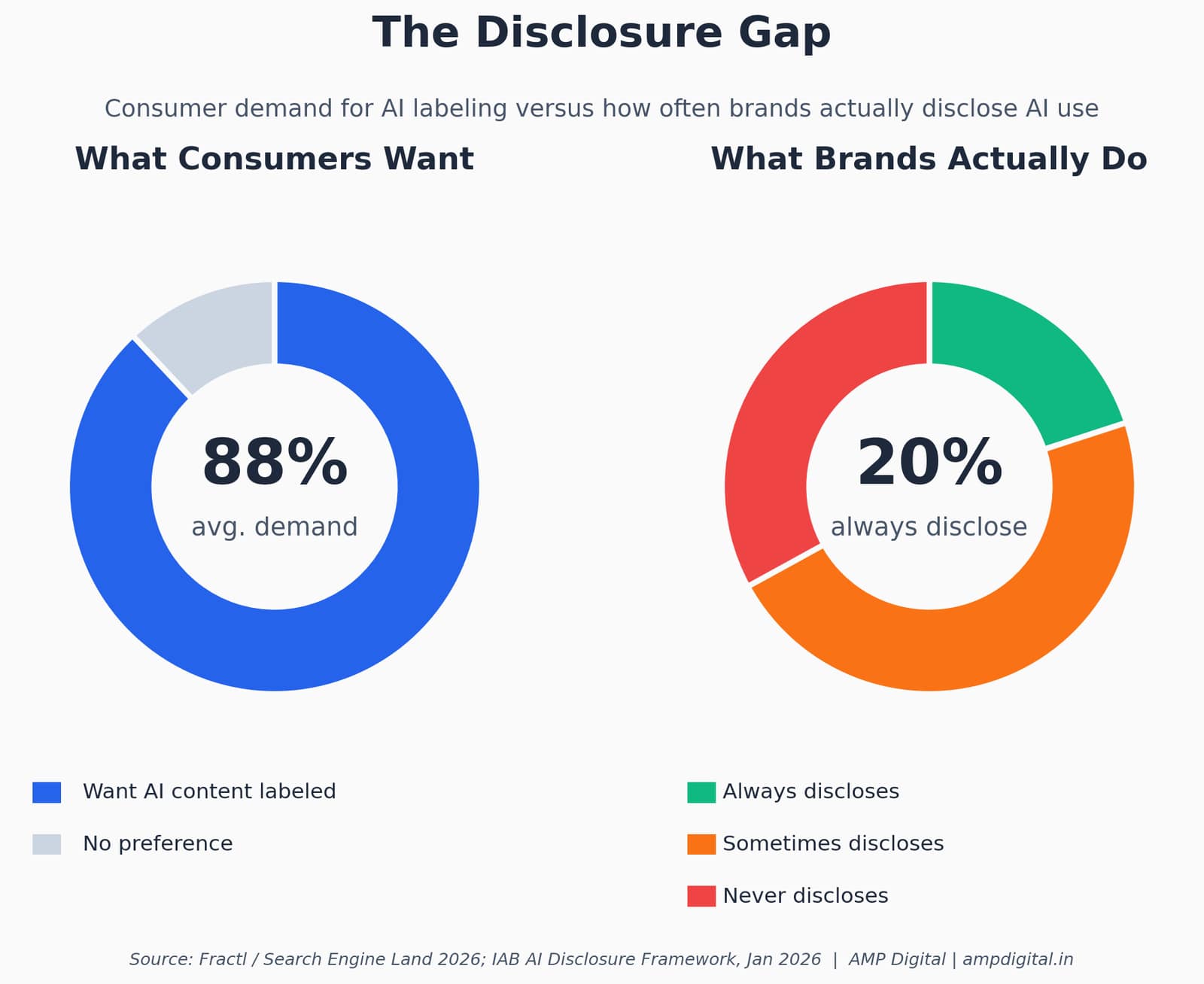
Most brands still aren’t closing this gap, which is exactly the opening thoughtful disclosure design can fill.
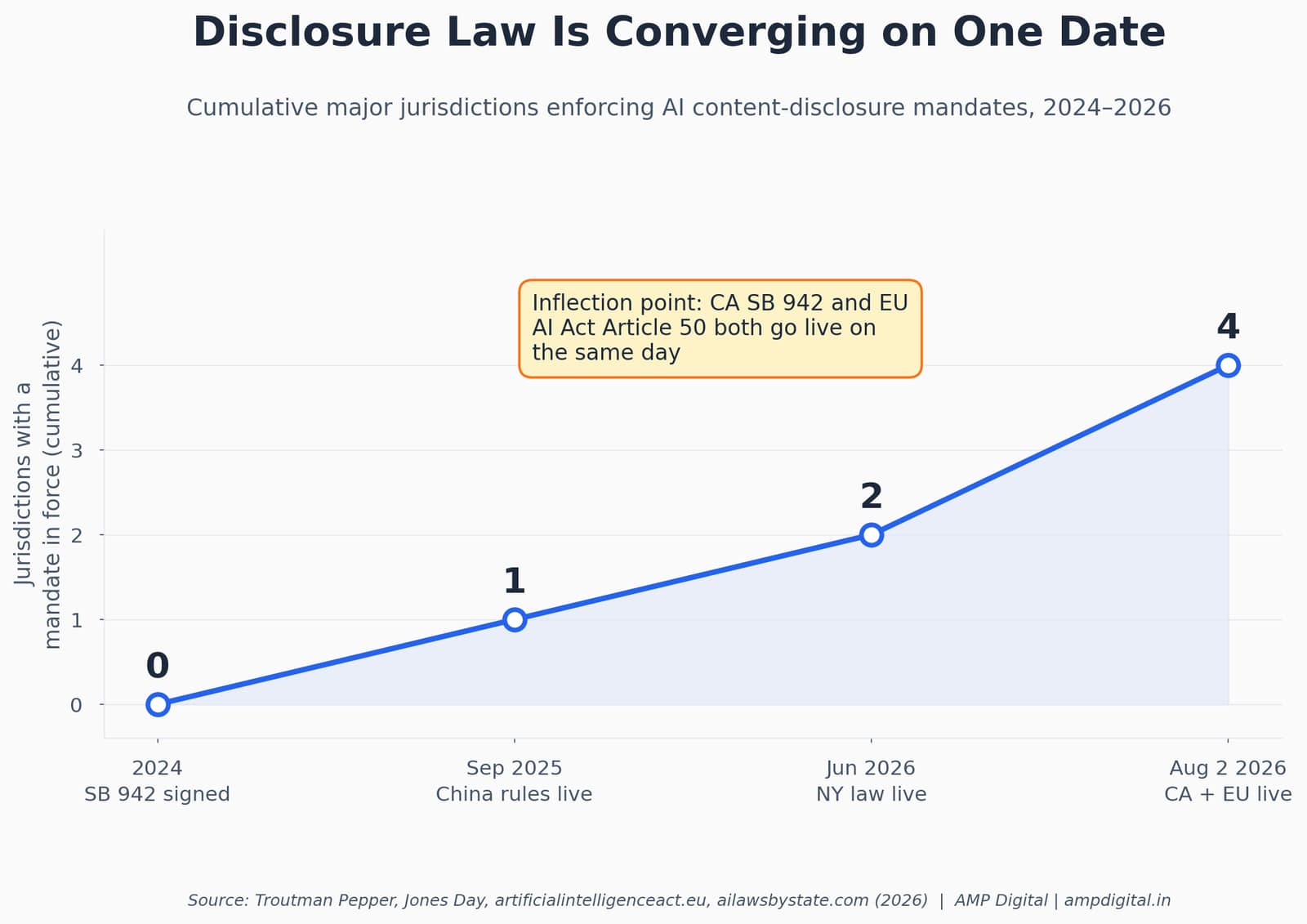
The regulatory floor is now set; the differentiation happens above it.
SUMMARY: The Starter Move Layered disclosure (visible front-end + embedded back-end) beats a single blanket label on every axis: it satisfies SB 942 and Article 50, survives re-sharing and compression, and reads to audiences as design rather than defensiveness. |
Download a creator compliance checklist or audit your recent content flow for provenance readiness today.
References
- Secure Privacy. "California AI Transparency Law: What Businesses Need to Disclose and Implement." 2026.
- Orrick. "Navigating the California AI Transparency Act: New Contract Requirements." 2025.
- Jones Day. "California Enacts AI Transparency Law Requiring Disclosures for AI Content." 2024.
- Troutman Pepper. "California AI Transparency Act Amendments Signed Into Law." 2025.
- AI Laws By State. "California AI Transparency Act (SB 942): 2026 Compliance Guide." 2026.
- Resemble AI. "The EU AI Act: What Generative AI Companies Need to Know in 2026." 2026.
- Greenberg Traurig LLP. "Deepfakes, Chatbots, AI-Generated Text: European Commission Details Transparency Obligations Under the AI Act." 2026.
- artificialintelligenceact.eu. "The EU AI Act’s Transparency Rules: A Practical Guide to Article 50." 2026.
- Bratby Law. "AI Act Article 50 Transparency Obligations: 2 August 2026." 2026.
- European Commission, Digital Strategy. "Code of Practice on Transparency of AI-generated Content." 2026.
- European Commission, Digital Strategy. "Quick Facts: Transparency rules for AI systems." 2026.
- Digital Applied. "AI Search Adoption Up, Trust Down: 2026 Data and Fixes." 2026.
- ContentGrip. "AI Disclosure Is Now a Brand Trust Decision." 2026.
- ContentGrip. "AI trust drops as usage rises, Fractl’s 2026 survey." 2026.
- DesignRush. "7 Brands Using ‘No AI’ Disclaimers to Win Consumer Trust." 2026.
- AuditSocials. "TikTok AI Content Policy 2026: 4-Tier Labels & Penalties." 2026.
- AuditSocials. "AI Content Label Rules 2026: Meta, Google, TikTok, YouTube." 2026.
- Cinerads. "TikTok AI Generated Content Policy 2026: AIGC Label Guide." 2026.
- Cinerads. "AI Ad Disclosure Requirements in 2026: Meta, TikTok, YouTube, and the EU Compared." 2026.
- Vexub. "YouTube AI Monetization Policy 2026: Rules, Disclosure, Tips." 2026.
- Cladegrove. "Do You Have to Disclose AI Content on Instagram and YouTube?" 2026.
- Content Authenticity Initiative. "The State of Content Authenticity in 2026." 2026.
- TextSight. "C2PA Content Credentials 2026 - What They Are and How to Verify." 2026.