
Google's Open Knowledge Format (OKF), Explained Simply: What It Is and What It Isn't (Yet)
A plain-English guide to OKF, why Google built it, and whether it has anything to do with SEO
Google quietly launched a new file format in June 2026. It has a boring name: the Open Knowledge Format, or OKF. It was built for a very specific job, helping AI agents find facts inside a company's own files.
But within days, SEO folks were already asking the obvious question. Does this help my content get found by AI? That is a fair question, but it is also the wrong question to lead with, and this article will show you why.
Here's what you'll get from reading this: a simple explanation of what OKF actually is, how it compares to things you already know (like schema.org and llms.txt), and a clear, honest answer on whether it matters for your SEO work today.
"OKF v0.1 is a starting point, not a finished standard."
Google Cloud, official OKF announcement, June 2026
What Is OKF, In Plain English?
OKF is a simple way to write down what a company knows, so an AI agent can read it directly. No guessing required.
Think about your own company for a second. Somewhere, someone knows exactly what "active user" means in your reports. Somewhere else, a Slack thread explains why a certain database table exists.
None of that is written down in one clean place. An AI agent trying to help with your data has to go hunting for it, every time, and it often guesses wrong.
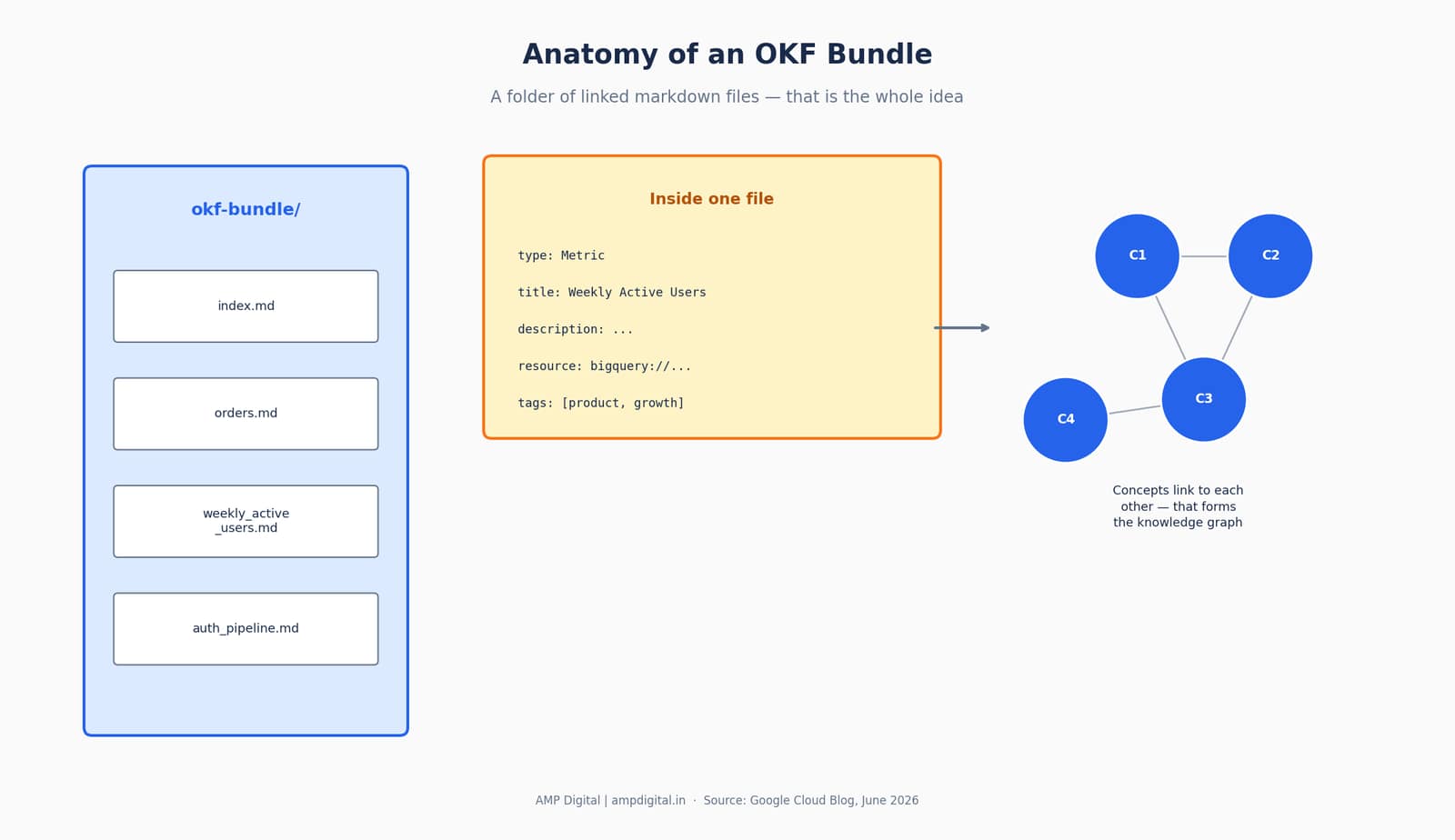
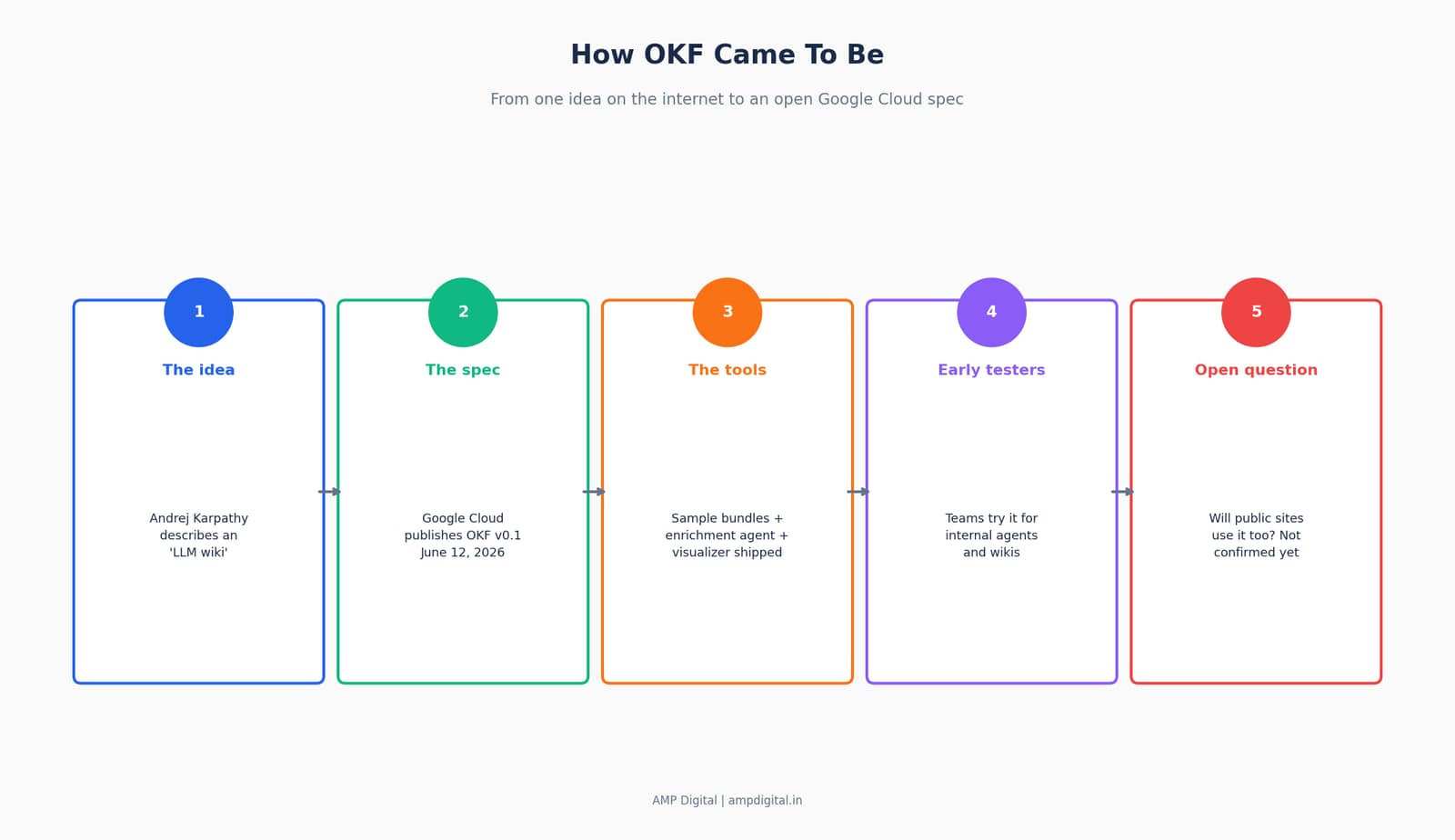
OKF fixes that by giving each piece of knowledge its own small file. Google Cloud published the format on June 12, 2026, describing it as "a starting point, not a finished standard." Every file is written in Markdown (the same simple text format used on GitHub and in note-taking apps like Obsidian and Notion) with a short block of information at the top called YAML frontmatter.
The 3 Layers of an OKF File
Layer | What It Is | Example |
Required field | The only thing every file must have | type: Metric |
Optional fields | Extra details that help, but aren't required | title, description, resource, tags, timestamp |
Free-form body | The actual explanation, written in plain Markdown | "This counts users who logged in during the last 7 days." |
Key Stat
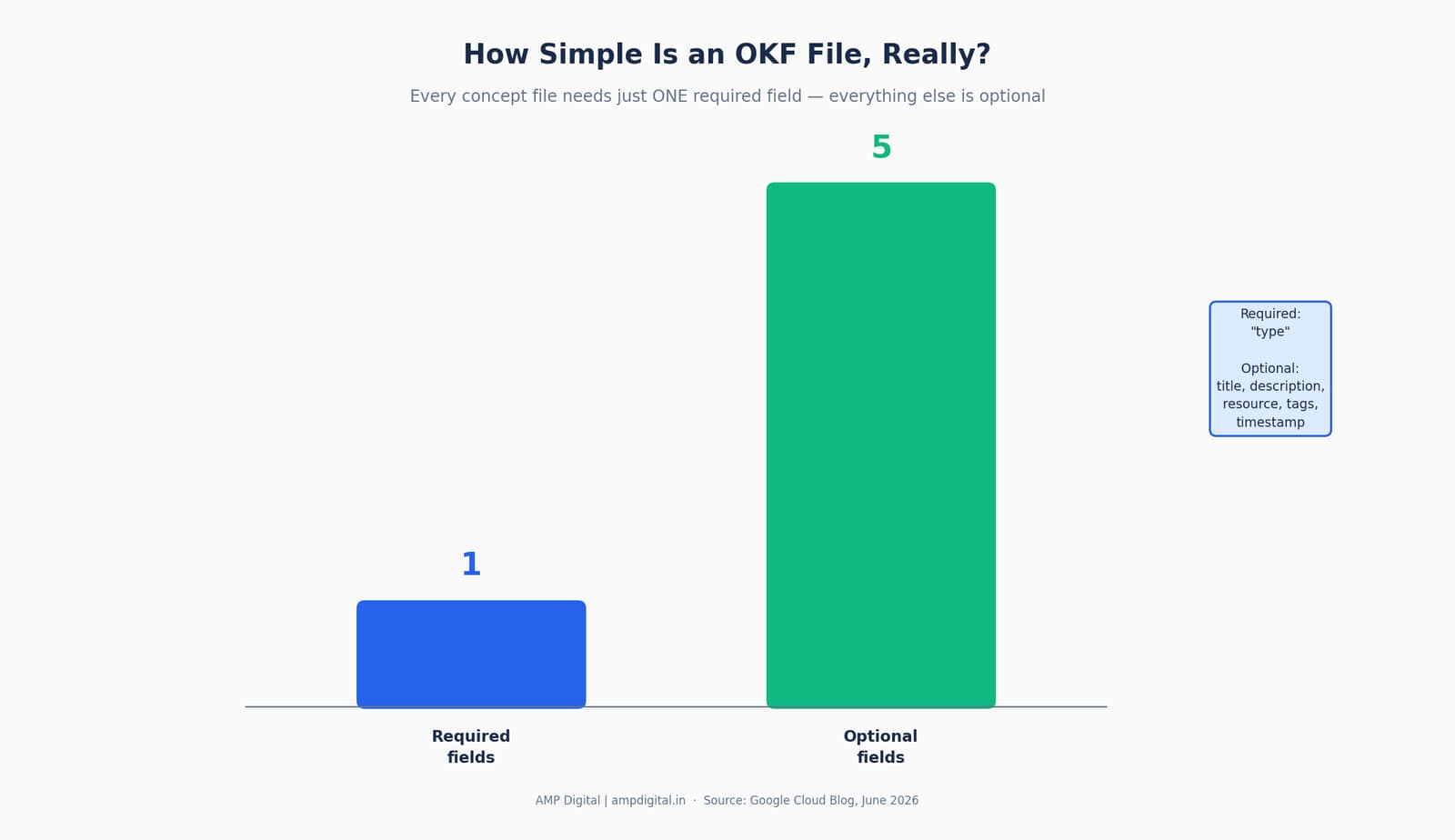
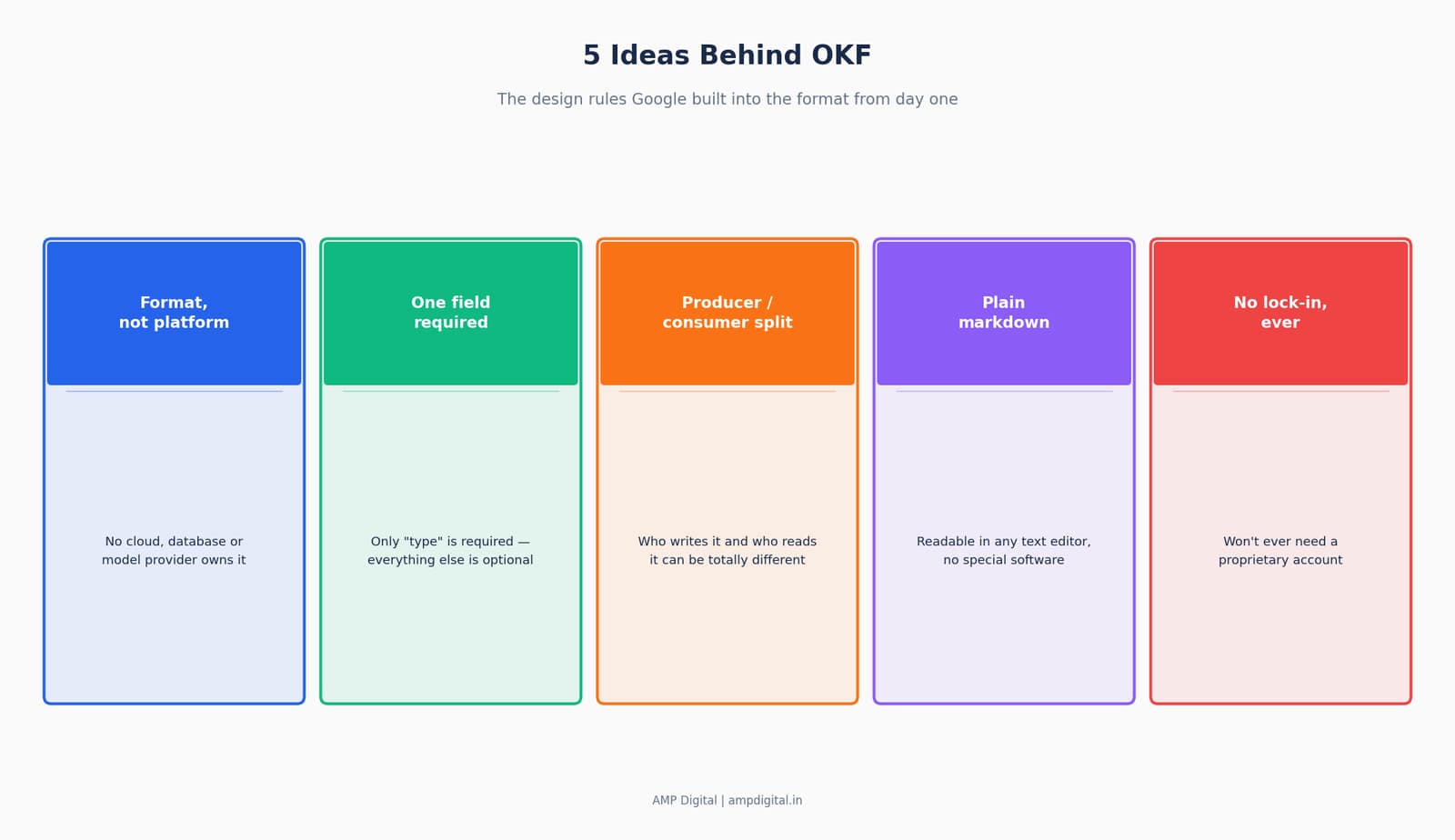
OKF v0.1 requires exactly ONE field ("type") to be a valid file. Everything else (title, description, resource, tags, timestamp) is your choice.
Why Does This Actually Matter?
Because right now, every AI agent solves the same knowledge problem from scratch, and that wastes time, money, and accuracy.
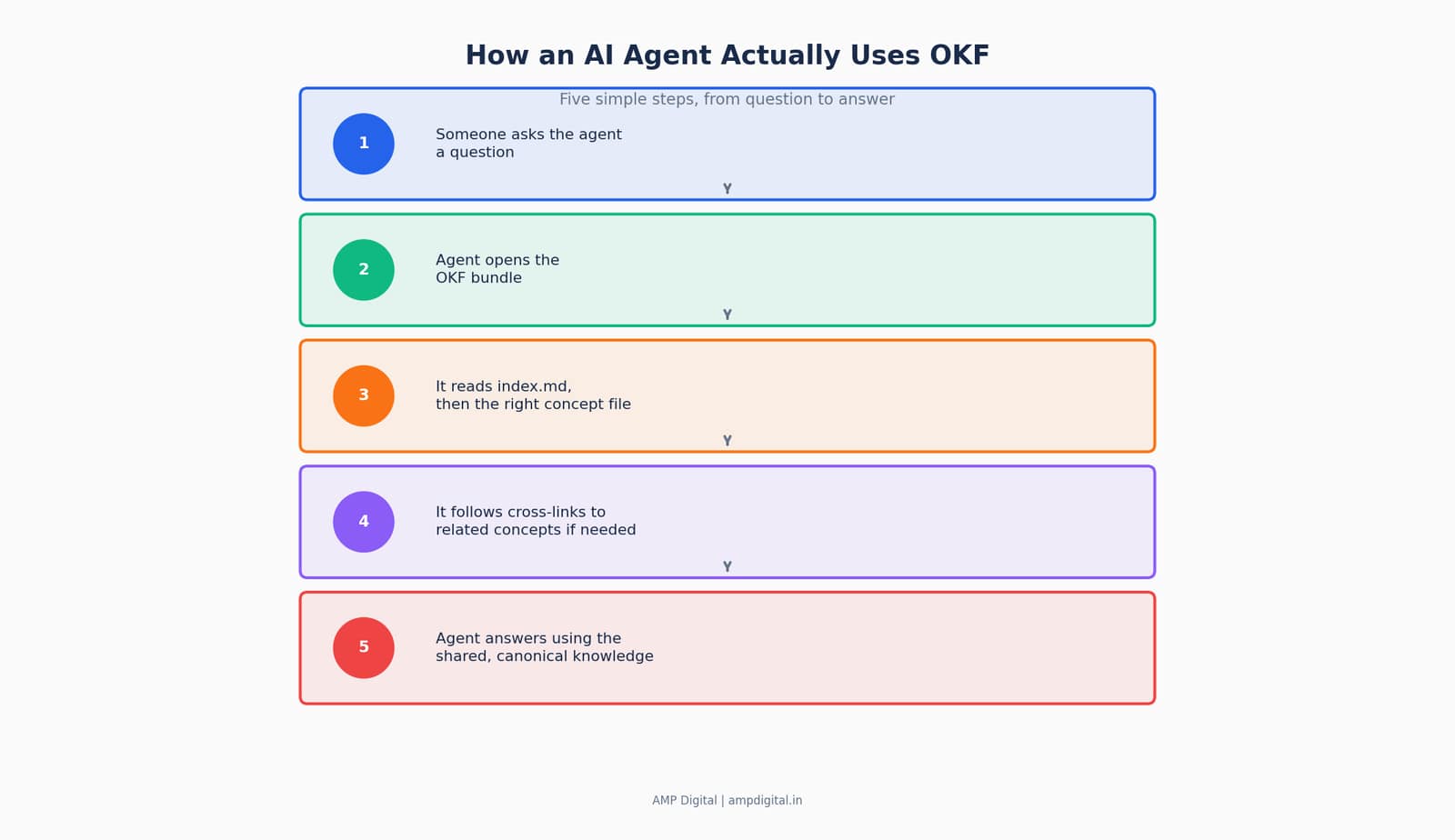
Picture an AI agent trying to answer: "How do I calculate weekly active users from our data?" Today, it has to dig through wikis, code comments, shared drives, and old Slack messages, and hope it lands on the right answer. Every agent, at every company, repeats this same painful process.
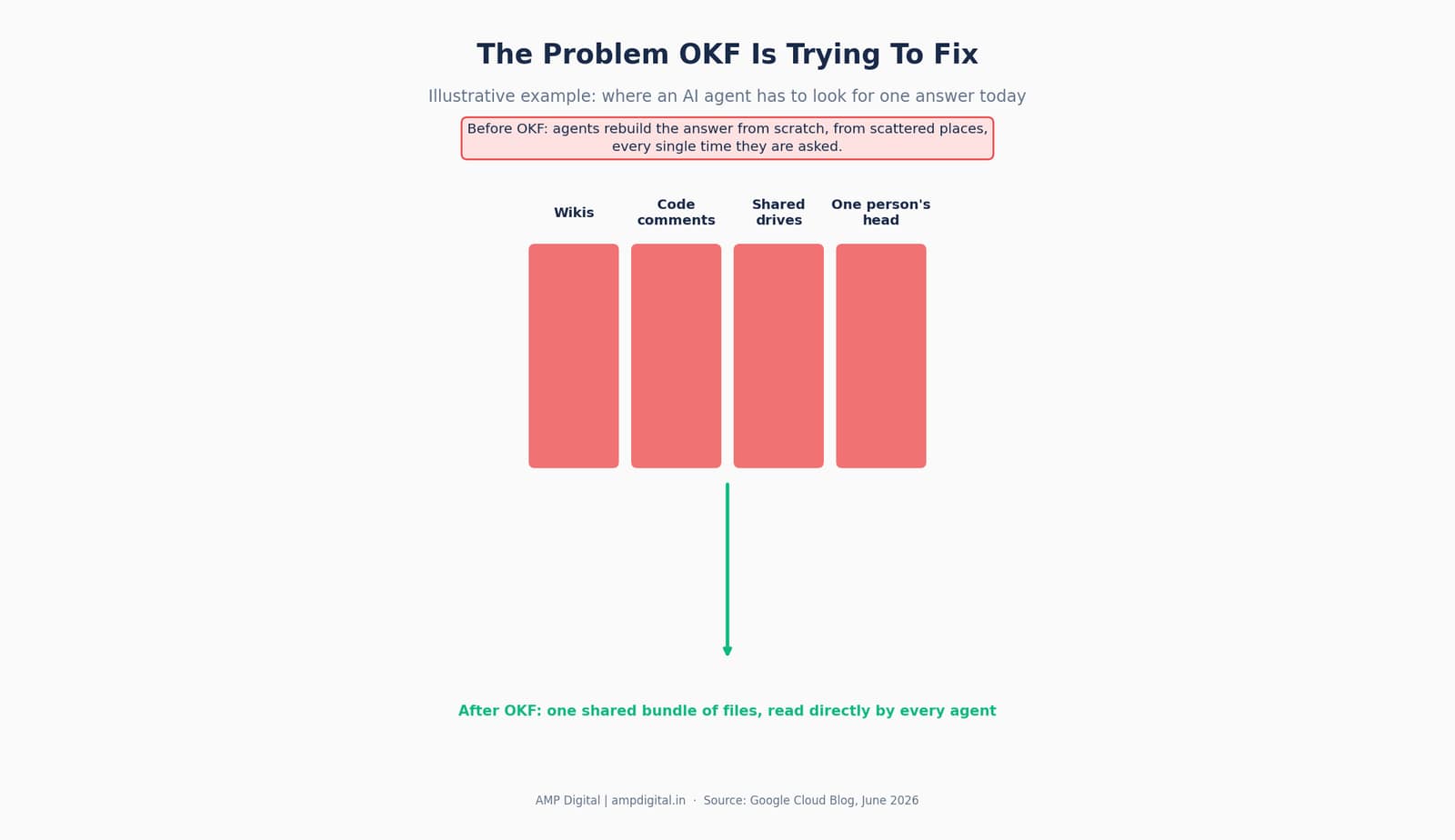
OKF's answer is simple: write the knowledge down once, in a shared format, and let every agent read the same file instead of rebuilding the answer from scratch.
"The bookkeeping that causes humans to abandon personal wikis is exactly what LLMs are good at."
Andrej Karpathy, AI researcher, quoted in Google Cloud's OKF announcement
Google backs this with real tools, not just a document. They shipped an enrichment agent that scans a BigQuery dataset and writes OKF files automatically, plus a visualizer that turns a folder of these files into an interactive graph you can click through.
Who Writes It, and Who Reads It?
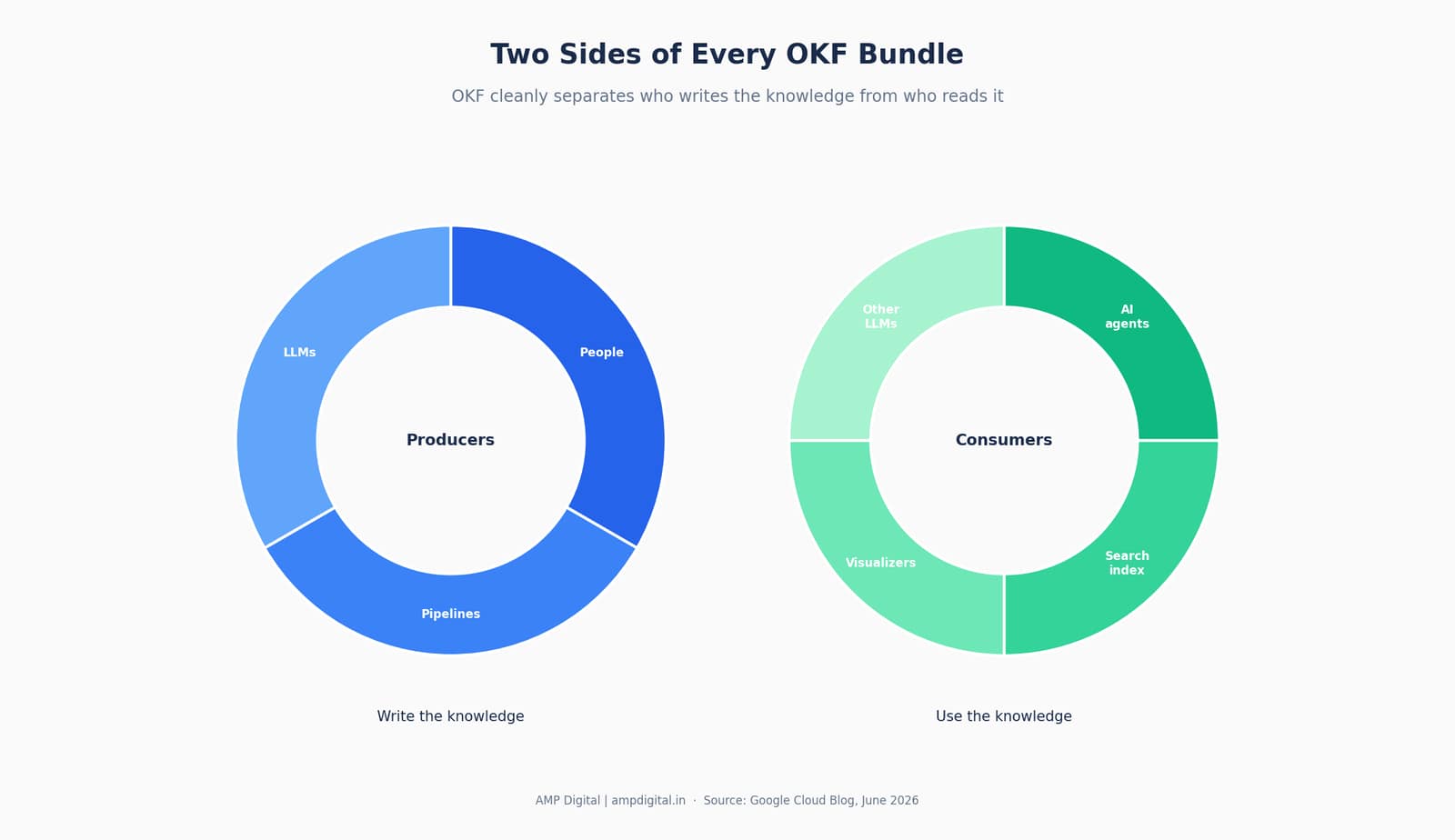
OKF cleanly separates the person (or system) writing the knowledge from the AI agent using it, and that split is the whole point.
A person can write an OKF file by hand. A script can generate one automatically from a database. An AI model can even draft one itself.
On the other side, the "reader" could be a coding agent, a company search tool, or a visual diagram generator. Neither side needs to know anything about the other.
What Does an OKF Bundle Actually Look Like?
It's just a folder of linked text files. Nothing fancier than that.
Google calls a single file a "document" and a folder full of them a "bundle." Files link to each other using ordinary Markdown links, the same `[link text](file.md)` style used on GitHub.
Once enough files link to each other, they stop being a random folder and start acting like a map. An AI agent can jump from one concept to the next, following the links exactly like you'd click through a wiki.
Pro Tip
If you've used Obsidian, Notion, or a personal wiki before, OKF will feel instantly familiar. It formalizes a habit a lot of people already had. It just makes it readable by machines too.
How OKF Compares to Things You Already Know
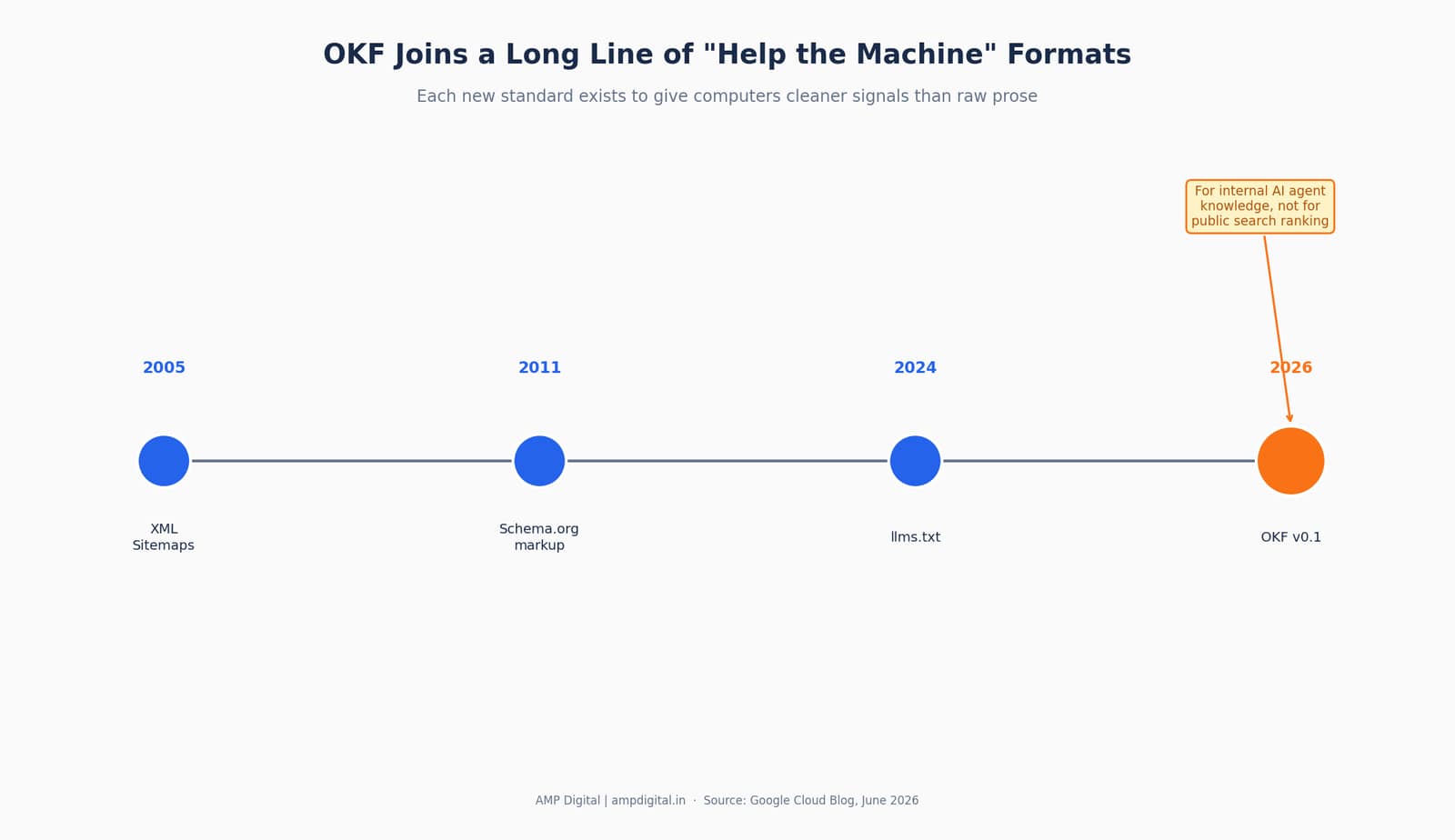
OKF is not the first attempt to make content easier for machines to understand. It's the newest one, and it's aimed at a different target than most.
SEO has always been about giving machines cleaner signals instead of making them guess. Sitemaps, schema.org markup, and canonical tags all exist for that exact reason.
OKF is built on the same instinct, just aimed at internal company knowledge instead of public web pages.
OKF vs. llms.txt: The Comparison Everyone Gets Wrong
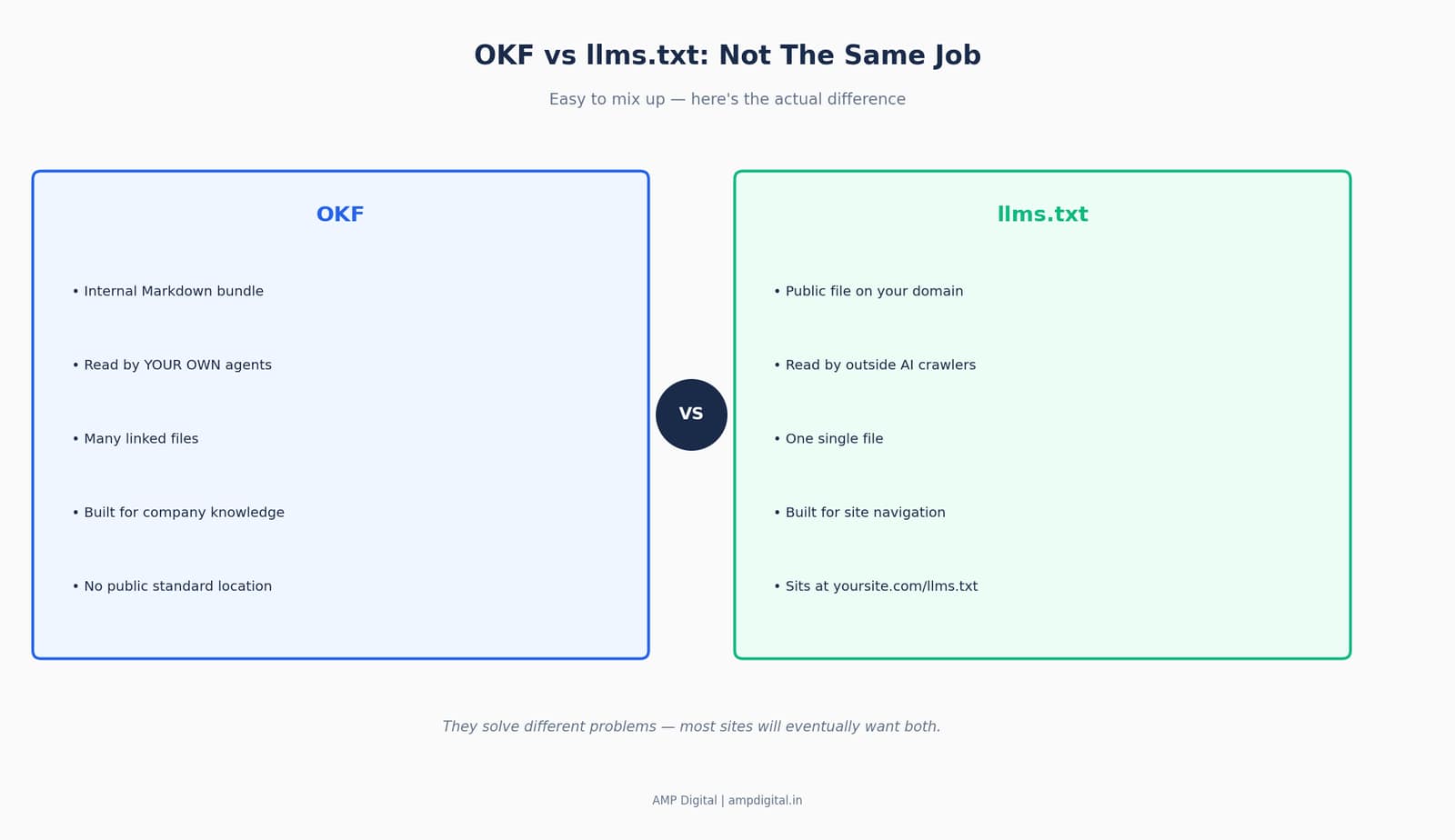
People keep mixing these two up, so let's be precise: llms.txt is a public file that sits on your website and tells outside AI crawlers how your site is organized. OKF is meant to be an internal bundle that your own company's agents read, so every one of your agents works from the same shared knowledge instead of reinventing it separately.
Where This Gets Speculative: Does OKF Help SEO?
Short answer: nobody knows yet, and Google has said nothing that points to public websites at all.
Here is where documented fact ends and genuine speculation begins, and it's worth being upfront about that line. Google built OKF for internal company knowledge: BigQuery tables, internal metric definitions, API docs, runbooks.
There is no mention of public websites, search visibility, or SEO anywhere in Google's own announcement.
Even so, some early adopters have started experimenting anyway. One website consultant built an OKF-style bundle describing his own site's core ideas, purely to see what would happen if an AI agent ever encountered it.
He was upfront that this is off-label use. Nothing confirms any AI agent is currently reading these bundles from the open web.
"It rests on reasoning by analogy, one early experiment, and the direction AI search seems to be heading, not on any statement from Google."
Industry analysis on the GAO (Generative Answer Optimization) case for OKF, 2026
The reasoning behind trying it is still worth understanding. Right now, when an AI agent reads your website, it usually gets a flat read: one page at a time, with no sense of how your ideas connect.
A structured, linked graph makes those connections explicit instead of leaving them implied. If AI agents ever start rewarding sources that make their idea connections clear, that would be a genuinely different kind of optimization than keyword-matching SEO.
That's the interesting bet here. Not that Google built OKF for this, but that the underlying habit of linking ideas explicitly might matter later, whether or not OKF specifically is the format that carries it.
Warning
Treat the SEO angle as a hypothesis worth testing at small scale, not a confirmed ranking factor, and not something to rebuild your content strategy around.
What Should You Actually Do About This Today?
Here's a simple, honest way to spend your time on this, split into what's worth trying, what isn't, and what to keep an eye on.
Low-Risk and Worth Trying
- Audit your existing content for places where related ideas sit near each other without ever stating the connection out loud. This is useful on its own, no OKF required.
- Pick 5 core concepts on your site and build a small, experimental OKF-style bundle. Treat it purely as a test.
- Watch how the linked files change the way you think about your own content structure. That discipline has value regardless of whether OKF catches on.
Not Worth Doing (Yet)
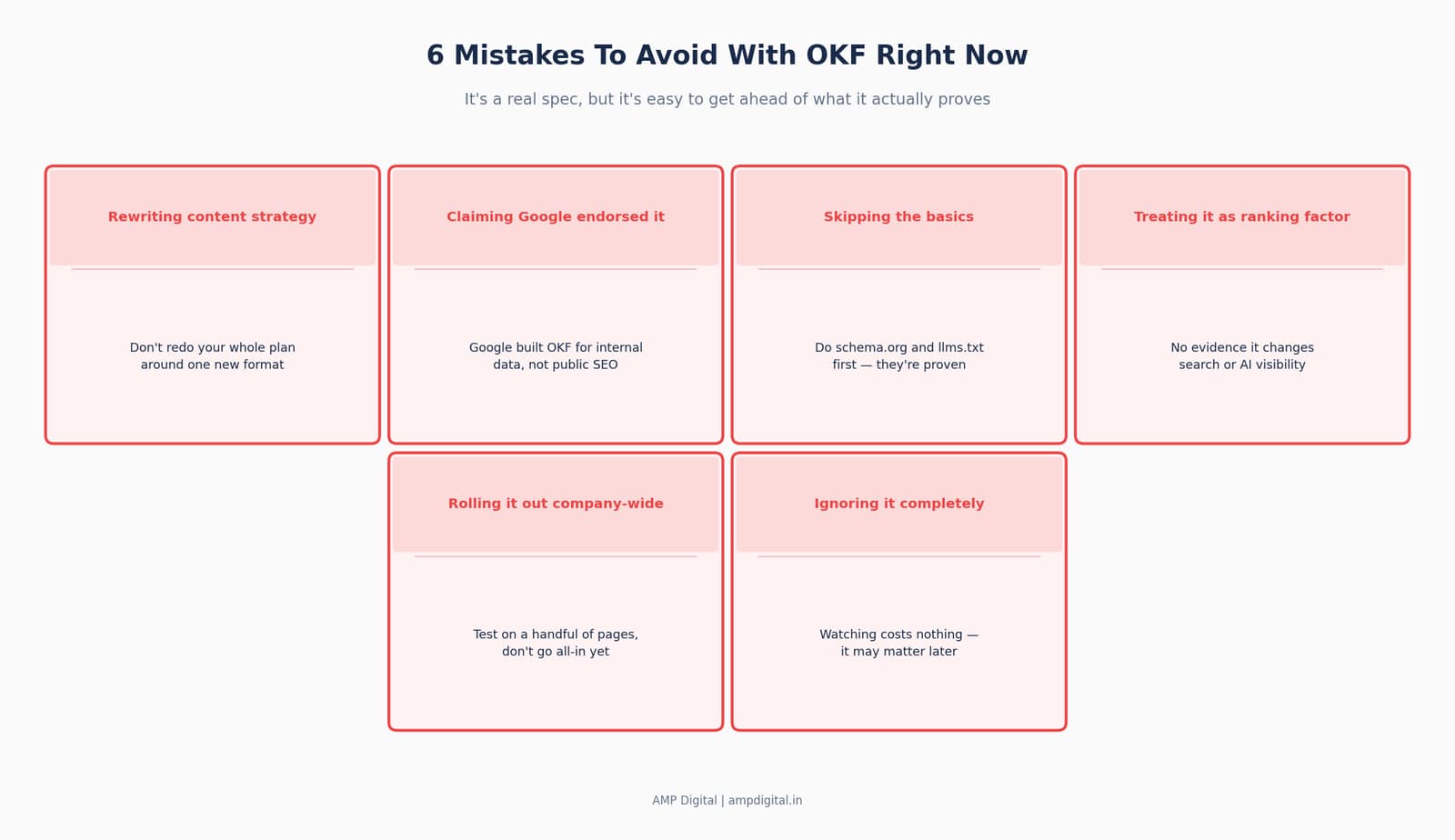
- Treating OKF as a confirmed ranking factor.
- Rewriting your whole content strategy around a six-week-old format.
- Telling clients or leadership that Google has "endorsed OKF for SEO." It hasn't. Say so plainly if asked.
Worth Watching
The one thing that would actually change this story: AI agents and answer engines starting to read structured knowledge bundles from public websites, at real scale. Right now, they largely don't.
That means the entire case for OKF-as-SEO depends on a shift that hasn't happened yet, and might not happen at all.
Update
Google describes OKF v0.1 as "a starting point, not a finished standard." Expect the spec itself to change as more companies try it and report back what works.
Frequently Asked Questions
What is Google's Open Knowledge Format (OKF)?
OKF is an open, free specification from Google Cloud, published June 12, 2026, for writing down organizational knowledge as a folder of linked Markdown files. It was built to help AI agents read facts like metric definitions, table schemas, and runbooks directly, instead of piecing them together from scattered wikis and documents.
Does OKF help SEO or Google Search rankings?
Not confirmed. Google built OKF for internal company knowledge and has said nothing about public websites, search rankings, or SEO. Some marketers are experimenting with public-facing OKF bundles anyway, but this is genuinely speculative. There's no evidence AI agents are reading these bundles from the open web yet.
Is OKF the same thing as llms.txt?
No. llms.txt is a public file on your website that tells outside AI crawlers how your site is organized. OKF is meant as an internal bundle that your own company's agents read, so they all share one canonical source of knowledge. They solve different problems and can work well together.
How is OKF different from schema.org markup?
Schema.org uses JSON-LD code embedded in web pages to help search engines understand public content. OKF uses plain Markdown files in a folder to help AI agents understand internal company knowledge. Same underlying idea (structure reduces guesswork for machines), but aimed at completely different audiences.
What's the one required field in an OKF file?
Just "type." Everything else (title, description, resource, tags, and timestamp) is optional. Google kept the spec deliberately minimal so a team could start using it in an afternoon.
Should my company start using OKF right now?
If you're running AI agents or RAG systems against your own company data and they keep getting facts wrong, yes. It's worth testing. If you're mainly focused on public-facing SEO, it's a low-priority, watch-and-wait format for now. Prioritize schema.org, llms.txt, and a real API first.
The Bottom Line
OKF is a real, useful format for a job most SEO teams don't actually have. Google built it to solve a genuine, internal headache, AI agents that can't find straight answers about a company's own data.
It does that job well, and it's free, open, and refreshingly simple to try.
Whether OKF ever becomes something that changes how your public content gets found by AI depends entirely on whether agents start reading these bundles from the open web at real scale. That hasn't happened yet, and it might never happen. What is worth carrying forward, regardless of OKF's fate, is the underlying habit: make the connections between your ideas explicit instead of implied. As machines move from reading pages one at a time to understanding graphs of ideas, that habit alone may end up mattering more than any single format.
Summary
Quick-start checklist:
1. Read Google's original OKF announcement on the Google Cloud blog
2. Audit your content for implied (but unstated) connections between ideas
3. Try a 5-file experimental OKF bundle if you run internal AI agents
4. Do NOT rebuild your SEO strategy around OKF yet
5. Keep watching for signs that public AI agents start reading these bundles
References
- Google Cloud Blog: "How the Open Knowledge Format can improve data sharing" (June 12, 2026)
- MarkTechPost: "Google Cloud Introduces Open Knowledge Format (OKF)" (June 2026)
- Search Engine Journal: "Google Cloud Announces The Open Knowledge Format"
- StartupHub.ai: "Google Open Knowledge Format (OKF): What It Is, the Spec, and How to Use It"
- Flowtivity: "Google's Open Knowledge Format: The Markdown Standard That Could Replace Your Wiki"
- OWOX: "What is OKF? Google's open knowledge format, explained"
- innFactory AI Consulting: "Open Knowledge Format (OKF): The Open Standard That Frees Your AI Knowledge From Silos"
- GoogleCloudPlatform/knowledge-catalog: official OKF specification and sample bundles, GitHub