
From Prompt Engineering to Agent Orchestration: The Practical Skill Stack Behind Marketing Teams That Are Actually Winning With AI
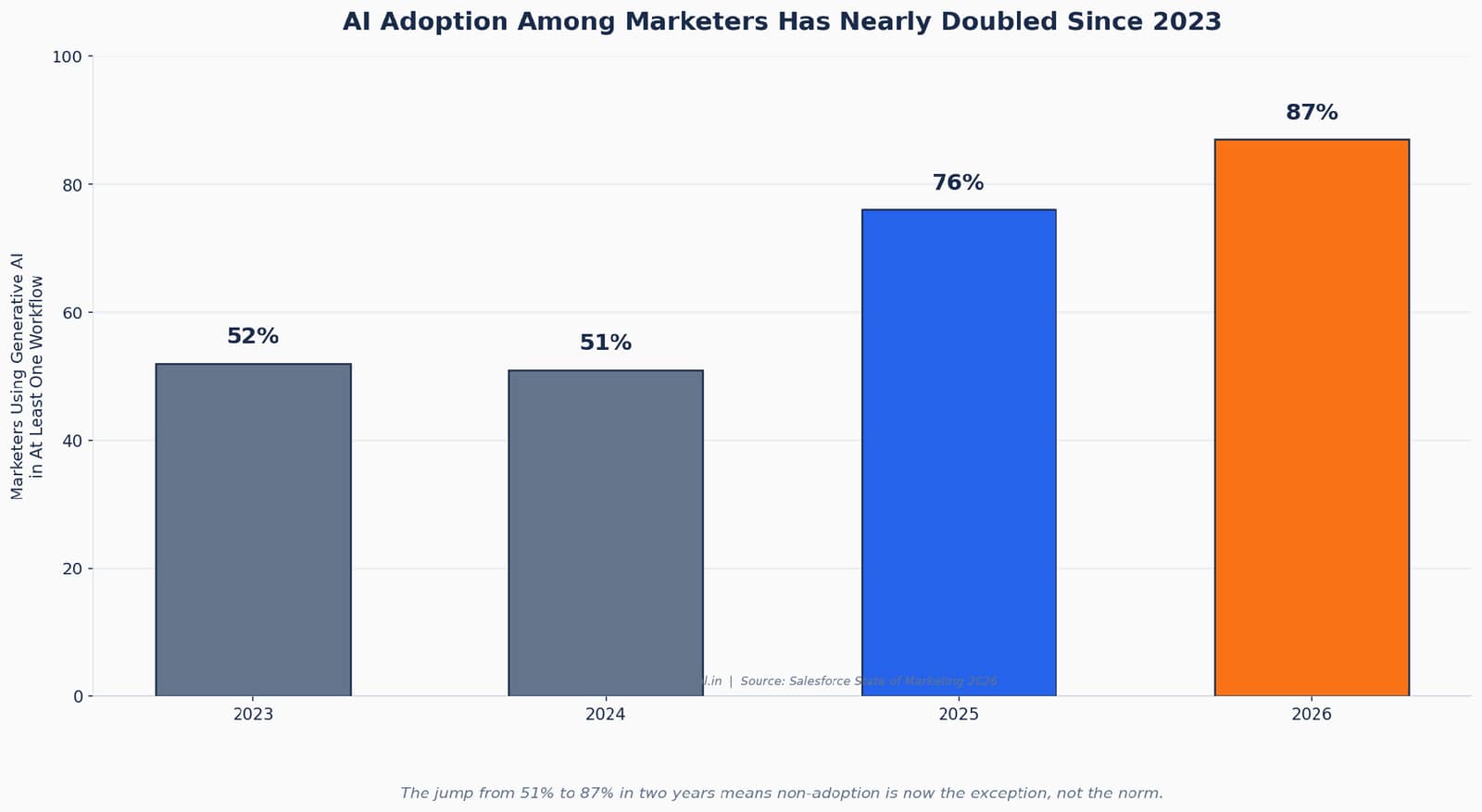
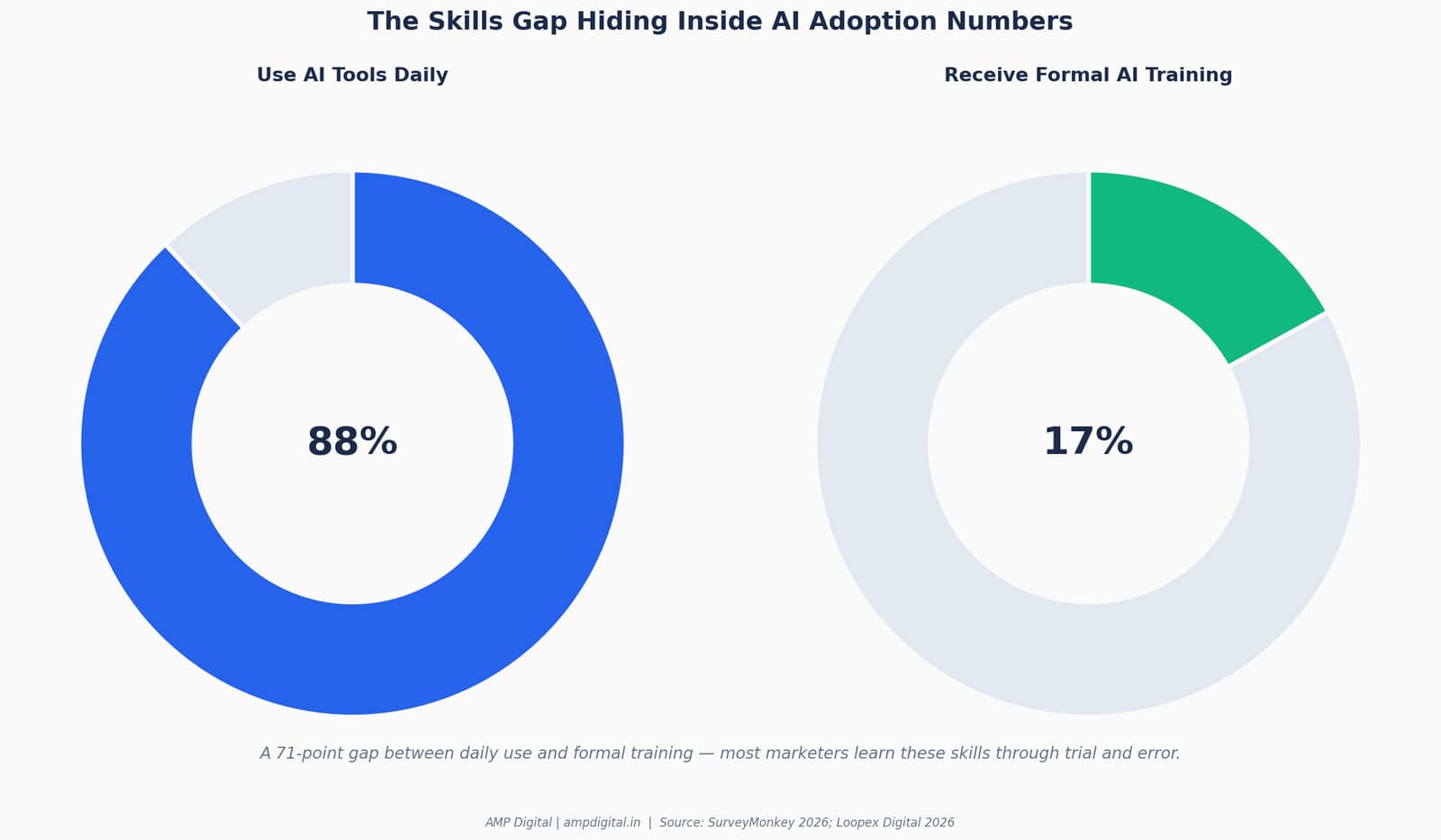
In 2026, 87% of marketers use generative AI in at least one recurring workflow, up from just 51% two years earlier — but only 17% of them have received any formal training on how to use it well. That gap between adoption and actual skill is where most of the wasted budget, generic content, and stalled ROI in modern marketing is coming from.
This guide breaks down the twelve AI skills that separate marketers who are genuinely operating faster and smarter from marketers who are simply typing more prompts into more tools. None of these are about becoming a data scientist. They are about knowing how to direct AI so it produces work worth publishing, defending, and scaling.
"The experiment is over and the operational era has begun. Marketing organizations are way beyond piloting and are operationalizing AI at scale." — Jasper, State of AI in Marketing 2026 |
|---|
By the end of this article, you will know exactly which of these twelve skills to prioritize first, how to build them into a 90-day plan, and which mistakes quietly undo the ROI that AI is supposed to deliver.
What Are "AI Marketing Skills" in 2026?
AI marketing skills are the practical, task-specific abilities that let a marketer direct AI tools to produce usable, on-brand, accountable work — not just the ability to open a chatbot and type a question. Fluency shows up on three layers: how you instruct AI, how you ground it in real brand and customer data, and how you govern what it produces before it reaches a customer.
Layer | What It Covers | Example Skill |
|---|---|---|
Instruction Layer | How you prompt, structure, and direct AI tools | Task-specific prompt engineering (Skill 1) |
Data & Orchestration Layer | How AI is grounded in your data and chained into workflows | RAG literacy, agent orchestration (Skills 3, 4) |
Governance Layer | How output is verified, disclosed, and edited before publishing | Ethics literacy, human-AI editing (Skills 10, 11) |
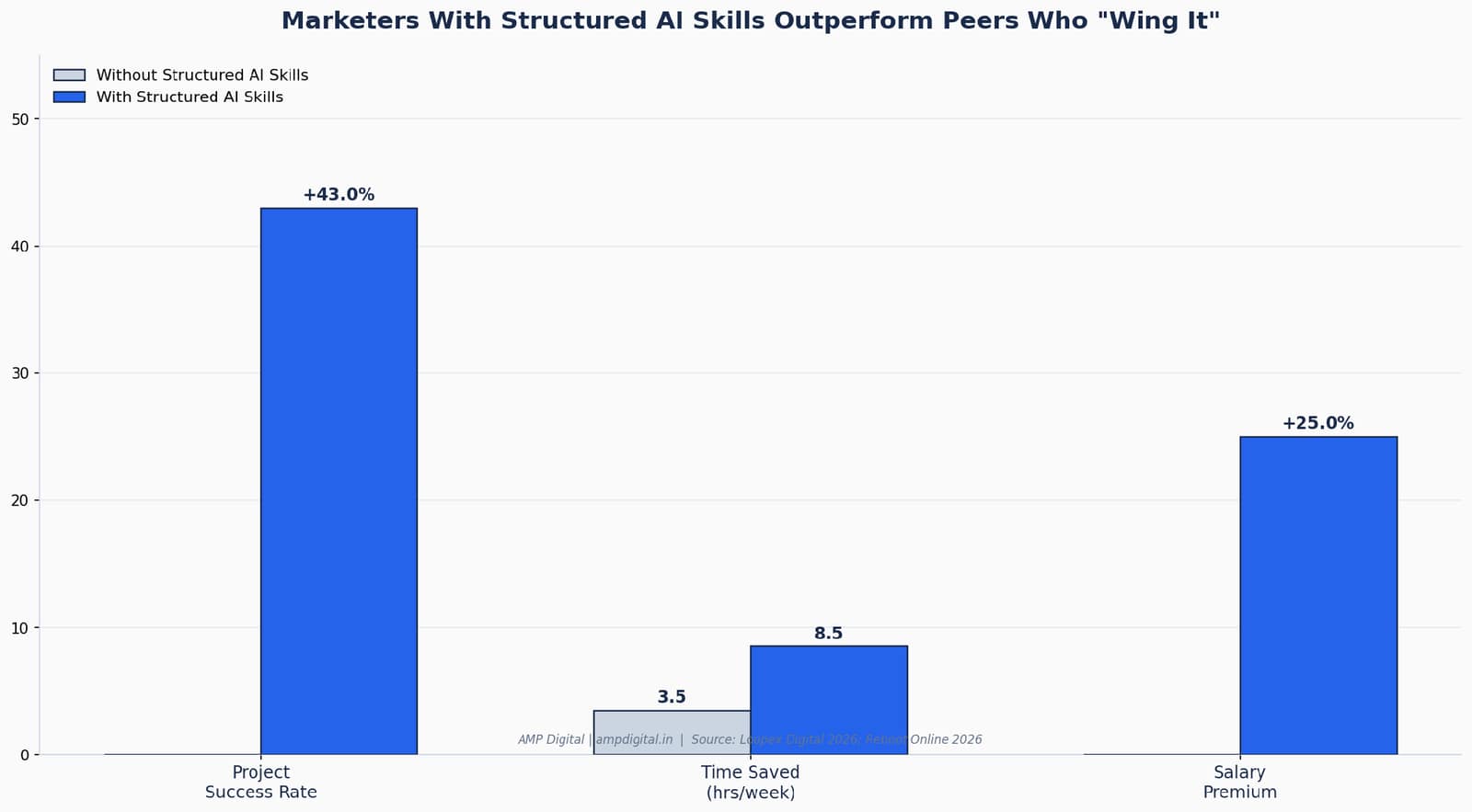
Key StatMarketing job listings requiring AI skills have increased 71% year over year, and AI-proficient marketers command a 20–30% salary premium over peers without AI skills listed on their profile. Source: Reboot Online 2026; Loopex Digital 2026 |
|---|
Why AI Marketing Skills Matter More Than AI Tool Access
Every marketer now has access to roughly the same tools. Access stopped being the differentiator once ChatGPT, Gemini, and Claude became standard line items in every marketing stack. What separates outcomes now is skill — the difference between a marketer who gets a usable draft on the first prompt and one who spends an hour re-prompting a mediocre result.
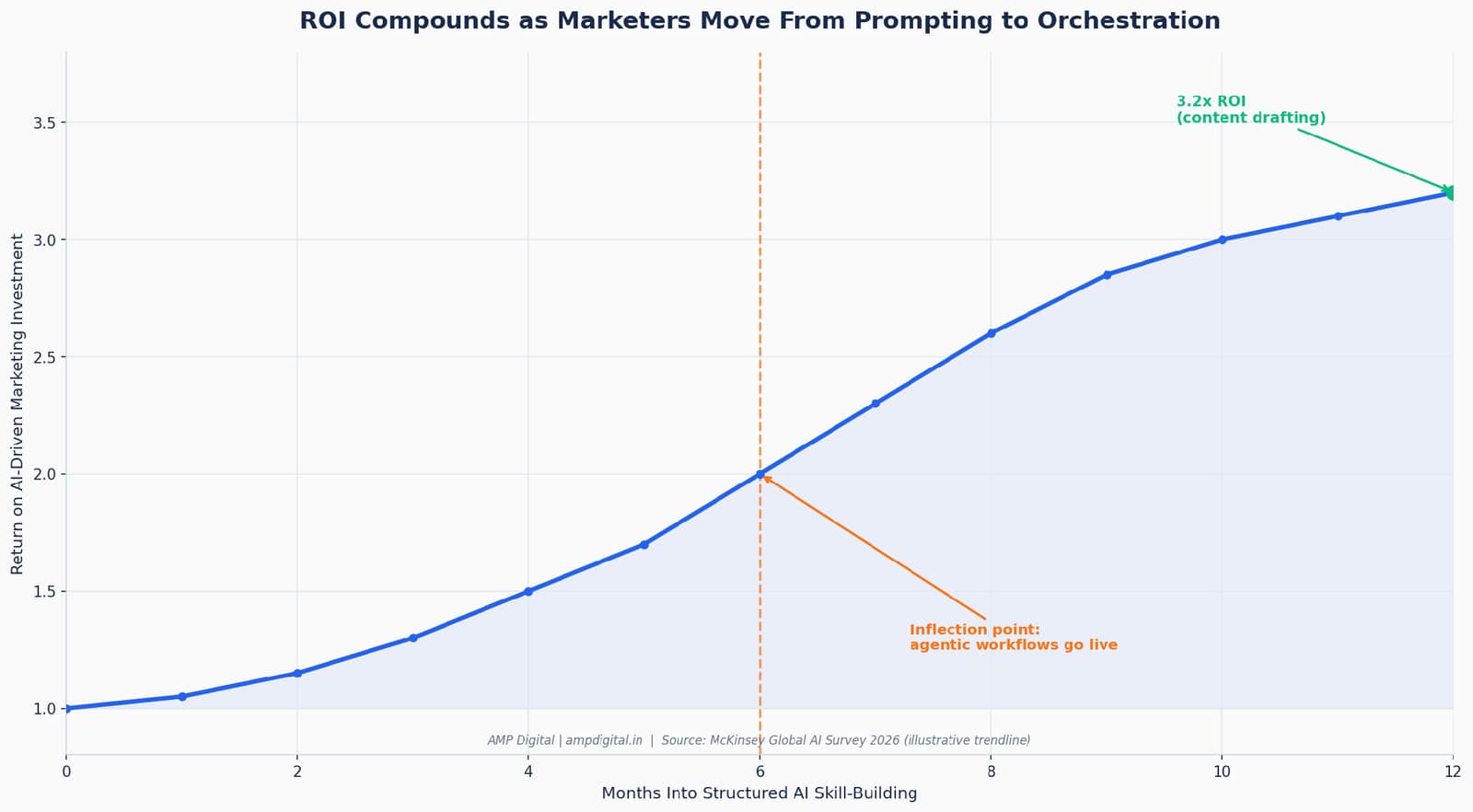
The ROI data backs this up by application, not by tool. According to McKinsey’s Global AI Survey, AI content drafting delivers 3.2x ROI on average, personalization engines return 2.7x, audience research 2.4x, and ad copy optimization 2.3x — but only when the underlying skill (grounding, prompting, orchestration) is in place. The tool alone does not produce the multiple.
Application | Average ROI Multiple | Skill Required |
|---|---|---|
AI content drafting | 3.2x | Prompt engineering + human editing |
Personalization engines | 2.7x | AI decisioning + data storytelling |
Audience research | 2.4x | AI-assisted persona building |
Ad copy optimization | 2.3x | Prompt engineering + synthetic testing |
"Marketing teams using AI strategically already see 44% productivity gains and 20–30% ROI improvements. The difference is the implementation." — Loopex Digital, AI Marketing Statistics Report 2026 |
|---|
The Foundation Skills: Skills 1–4
1. Prompt Engineering for Marketing Workflows
This is not generic prompting. It is task-specific prompting for briefs, ad copy variants, customer segmentation, and campaign ideation, where the skill is structuring context, constraints, and examples so the output is usable on the first try, not the fifth.
- Give the model role, audience, and constraint context before the ask — not after.
- Include one or two examples of "good" output in the prompt itself (few-shot prompting).
- Specify format explicitly: word count, tone, structure, what to exclude.
- Separate the brief from the execution: draft the brief once, reuse it across variant prompts.
Pro TipBuild a prompt library per content type (ad copy, briefs, segmentation) rather than reinventing prompts each time. Store the winning version, not every attempt. |
|---|
2. AI-Assisted Customer Research & Persona Building
This skill uses AI to synthesize reviews, support tickets, survey data, and social listening into sharper personas, faster than traditional research cycles, without losing nuance. The output is only as good as the range of raw inputs fed into it — a persona built from support tickets alone will over-index on complaints.
- Feed AI multiple raw sources (reviews, tickets, transcripts) rather than a single dataset.
- Ask the model to flag contradictions across sources, not just summarize them.
- Validate synthesized personas against at least one live customer conversation per quarter.
3. Retrieval-Augmented Content Creation (RAG Literacy)
RAG literacy means understanding how to feed brand guidelines, past campaigns, and proprietary data into AI tools so the output sounds like the brand, not generic AI voice. You do not need to build the retrieval system yourself, but you need to know why grounding changes what comes out the other end.
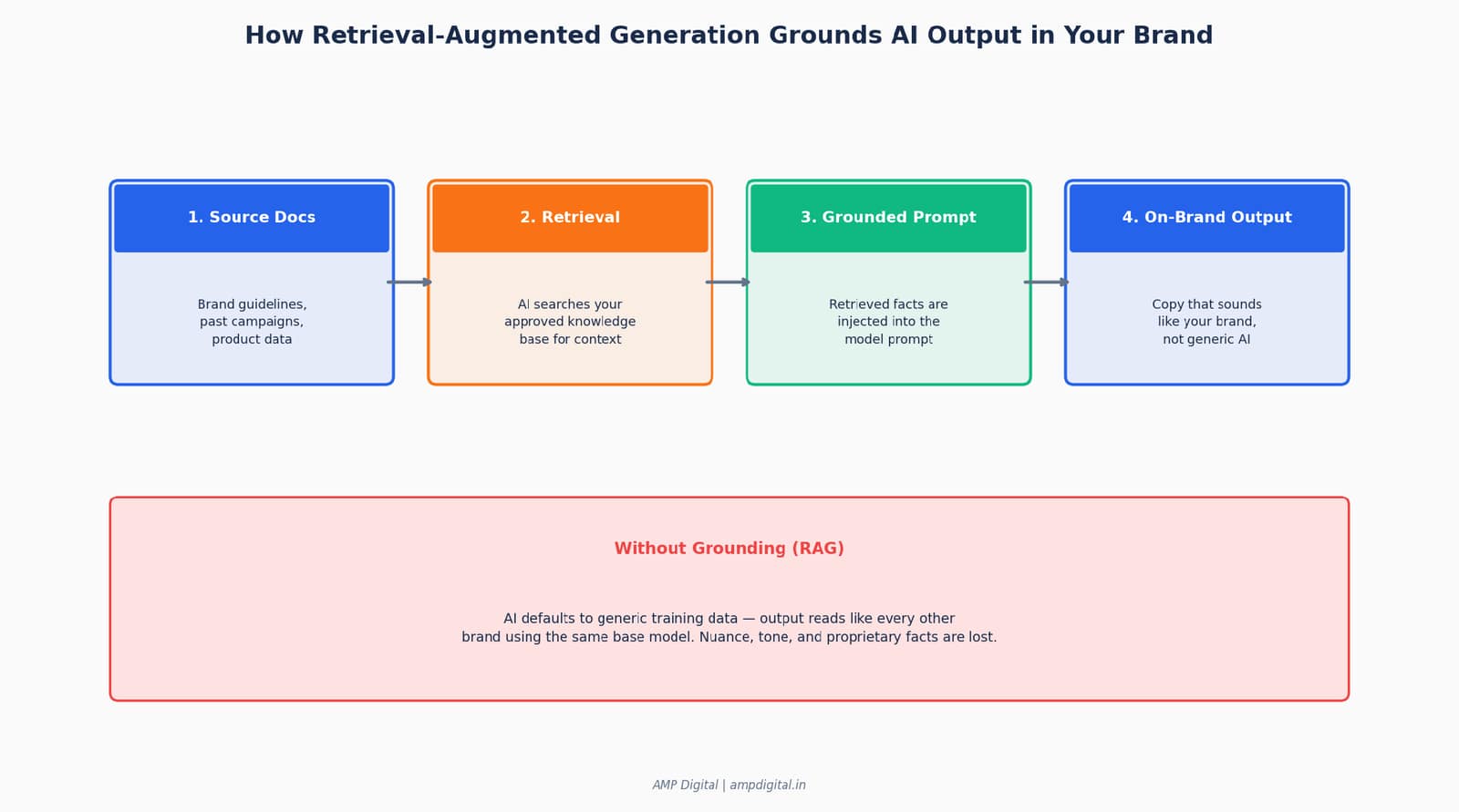
Without grounding, AI defaults to whatever pattern is most statistically common across its training data, which is precisely why so much AI-generated marketing copy sounds interchangeable across competing brands.
WarningSkipping RAG grounding is the single most common reason AI copy gets flagged internally as "sounding like AI." The fix is rarely a better prompt — it is feeding the model your actual brand voice guide and past top-performing campaigns as retrievable context. |
|---|
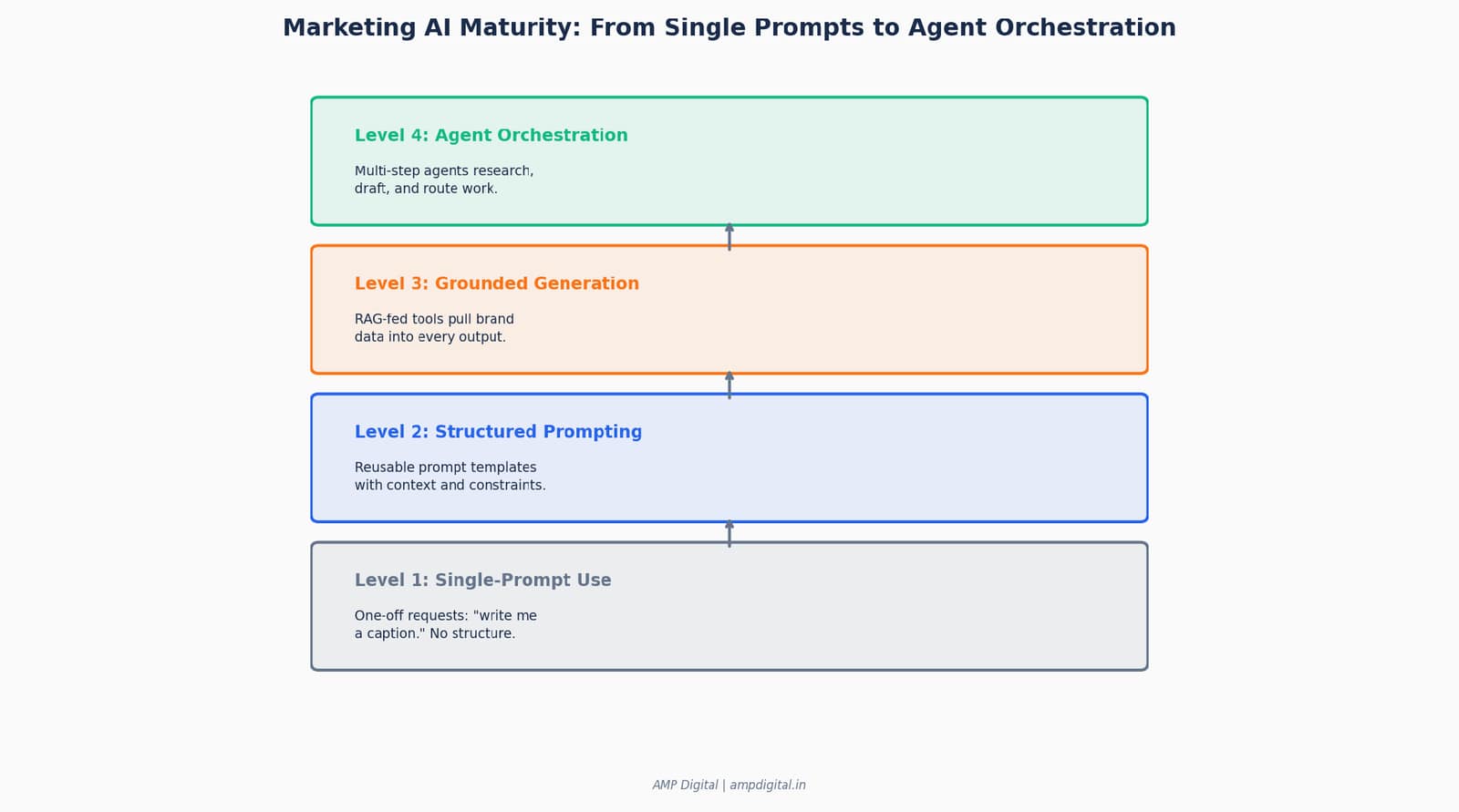
This skill is setting up simple multi-step agent workflows — for example, an agent that pulls competitor ads, summarizes them, and drafts a counter-positioning brief — rather than treating AI as a single-prompt tool. Orchestration is where the productivity curve bends upward.
Maturity Level | Typical Output | Time Investment |
|---|---|---|
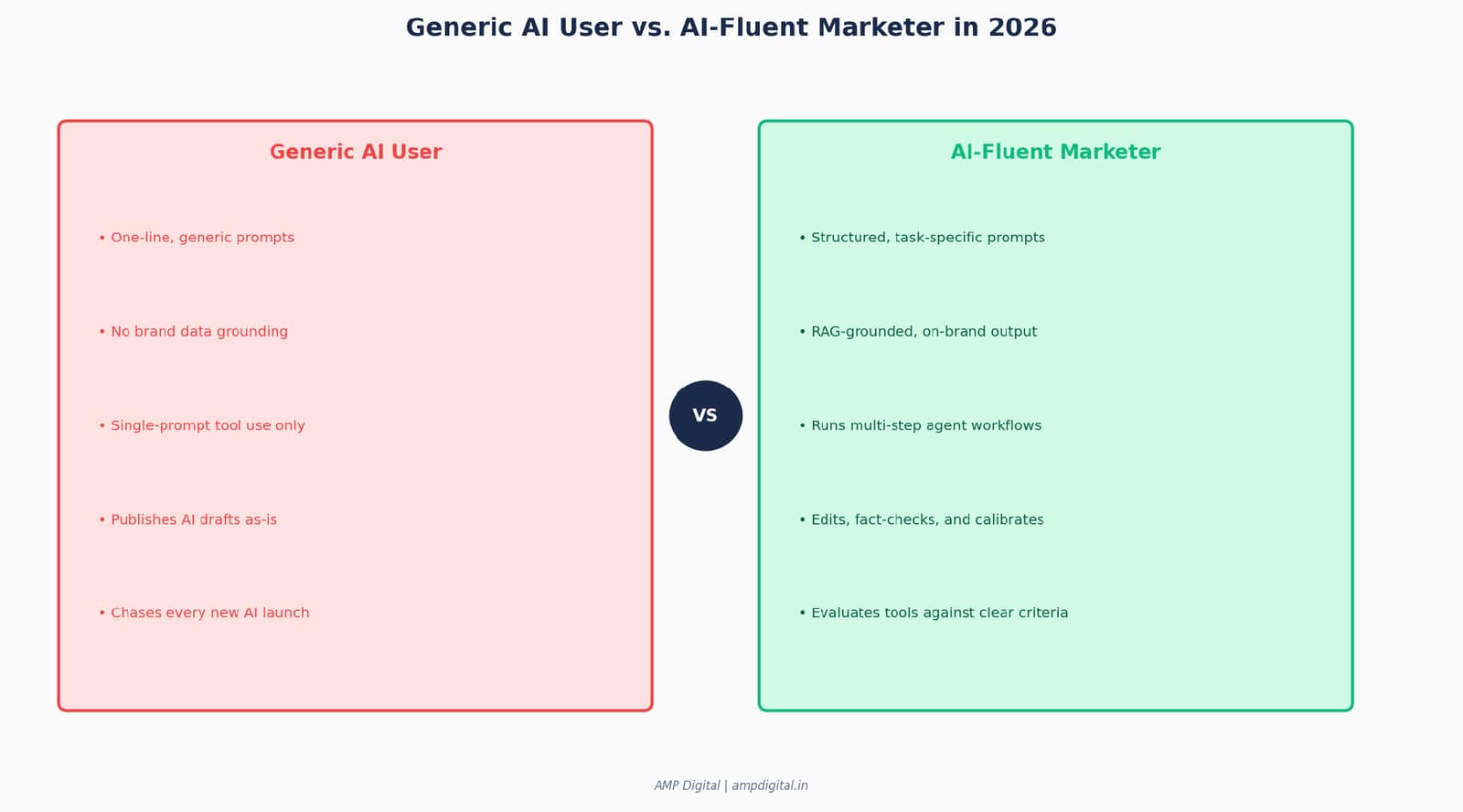
Single-prompt use | One-off drafts, inconsistent quality | Low upfront, high ongoing |
Structured prompting | Reusable, higher-quality drafts | Medium upfront, low ongoing |
Grounded generation (RAG) | On-brand output at scale | Medium-high upfront |
Agent orchestration | Multi-step workflows run with light oversight | High upfront, very low ongoing |
Visibility & Testing Skills: Skills 5–6
5. AI-Powered SEO & Answer-Engine Optimization (AEO)
This goes beyond keyword SEO into optimizing content to be cited by AI search and answer engines, understanding E-E-A-T signals, and structuring content so large language models can surface it correctly. In 2026, AEO builds on SEO fundamentals rather than replacing them — strong SEO still gets content indexed and discovered; AEO adds the structure AI systems need to extract and cite it.
- Lead every section with a direct, one-sentence answer before adding context.
- Use specific numbers and named examples — vague claims give AI nothing to cite.
- Refresh cornerstone content quarterly; AI answer engines favor recently updated pages.
- Add FAQPage, Article, and Author schema so AI systems can confirm authorship and intent.
"LLMs in 2026 frequently apply a "majority rule" for brand facts. If multiple third-party sources describe your brand consistently, AI models will report that as established fact rather than opinion." — Bigeye Agency, Answer Engine Optimization Guide 2026 |
|---|
Key StatVisitors arriving through AI citations spend 38% longer on site and show a 27% lower bounce rate than traditional organic search visitors, making the average AI search visitor worth roughly 4.4x more from a conversion standpoint. Source: Adobe Digital Insights, cited in Bigeye Agency AEO Guide 2026 |
|---|
6. Synthetic Audience Testing
This skill uses AI to simulate audience reactions to messaging and creative before spending media budget — a workflow that did not really exist in a fast, cheap form until generative AI made rapid simulation possible. It is not a replacement for live testing, but a filter that catches weak concepts before they reach paid media.
- Use synthetic testing to eliminate the bottom third of concepts, not to pick the final winner.
- Simulate across multiple persona profiles, not one generic "average customer."
- Validate synthetic predictions against a small live A/B test before scaling spend.
Creative & Automation Skills: Skills 7–8
7. AI-Generated Creative Direction (Not Just Generation)
This is the skill of art-directing AI image and video tools: prompting for brand-consistent visuals, iterating efficiently, and spotting when AI output needs human correction. Generating an image is easy; generating one that matches brand color systems, composition standards, and product accuracy takes direction.
- Build a reusable visual style prompt (lighting, composition, color palette) per brand.
- Always generate multiple variants and select, rather than accepting the first output.
- Check AI-generated product visuals against real product specs before publishing — AI regularly invents details.
8. Marketing Automation With AI Decisioning
This skill goes beyond "if this, then that" automation into AI-driven decisioning: dynamic send-time optimization, personalized sequencing, and adaptive campaign logic that changes based on real-time signals rather than fixed rules.
Automation Type | Logic | Example |
|---|---|---|
Rule-based automation | Fixed if/then triggers | Send email 3 days after signup |
AI decisioning | Model predicts optimal action per user | Send time and channel chosen per individual |
Adaptive sequencing | Path changes based on live engagement signals | Sequence reorders based on click behavior |
Best PracticeStart AI decisioning on one variable at a time (send time, then channel, then content variant). Layering all three at once makes it impossible to diagnose what is actually driving the lift. |
|---|
Insight & Governance Skills: Skills 9–10
9. Data Storytelling With AI
This skill turns raw analytics and dashboards into narrative insights for stakeholders, using AI to draft the "so what" behind the numbers rather than just reporting the numbers themselves. A dashboard tells you what happened; data storytelling tells leadership what to do about it.
- Ask AI to draft three possible explanations for a metric change, then verify with a human check.
- Pair every chart with one sentence stating the business implication, not just the trend.
- Use AI to draft the narrative first, then edit for accuracy — never publish AI’s causal claims unchecked.
10. AI Ethics & Disclosure Literacy
This is knowing platform policies from Meta, Google, and LinkedIn on AI-generated content disclosure, understanding bias risks in AI targeting, and being able to explain AI use to clients or leadership responsibly. In 2026, this shifted from a nice-to-have into an enforced compliance requirement.
Platform | 2026 Disclosure Requirement | Enforcement |
|---|---|---|
Meta (Facebook/Instagram) | Mandatory "AI-generated" label on ads with synthetic people, altered demos, or AI audio/video | Ad rejection; account restrictions for repeat violations |
Google Ads | Advertisers must disclose generative AI use; manual disclosure control for non-Google AI tools | Policy enforcement tied to existing ad review process |
LinkedIn / Industry-wide | Self-regulatory frameworks developing via IAB, ANA, and 4A’s | Platform-specific; state and FTC rules apply in parallel |
WarningThe FTC brought its first enforcement action specifically targeting undisclosed AI-generated advertising content in late 2025, with penalties up to $53,088 per incident. Disclosure is no longer a brand-safety nice-to-have — it is a compliance obligation with a dollar figure attached. |
|---|
Editorial & Meta Skills: Skills 11–12
11. Human-AI Collaborative Editing
This is the editorial skill of knowing exactly where an AI draft ends and human judgment begins: brand voice calibration, fact-checking, and knowing when not to use AI output as-is. It is the skill that most directly protects a brand from publishing something that is fluent but wrong.
- Treat every AI draft as a first pass, never a final version, regardless of how polished it reads.
- Fact-check every statistic, quote, and named claim before publishing — AI models fabricate confidently.
- Calibrate tone against three to five real examples of the brand’s actual published voice.
"Only 13% of marketers fully trust AI insights without human checks. The vast majority sit in a "trust but verify" middle, with 33% validating AI insights through human review." — TechnologyChecker.io, AI in Marketing Statistics 2026 |
|---|
12. AI Tool Stack Evaluation
This is the meta-skill of evaluating new AI tools quickly: knowing what questions to ask about data privacy, integration, output quality, and cost per use, rather than chasing every new launch. With more than 15,500 MarTech tools on the market in 2026, evaluation speed itself has become a competitive skill.
Evaluation Question | Why It Matters | Red Flag |
|---|---|---|
Where does our data go? | Determines privacy and IP exposure | Vague or missing data retention policy |
Does it integrate with our stack? | Determines real adoption vs. shelf-ware | Requires manual export/import for core workflows |
What is the cost per real use? | Prevents paying for unused seats/features | Pricing tied to seats, not usage or output |
Can we audit its output quality? | Determines whether it is production-ready | No way to review, correct, or trace outputs |
Best PracticeOnly 31% of marketers report high confidence when selecting AI tools. Build a standing four-question evaluation checklist (data, integration, quality, cost) and apply it to every new tool before a pilot, not after. Source: Statista Marketing Technology Report 2025 |
|---|
Where the 12 Skills Fit Together
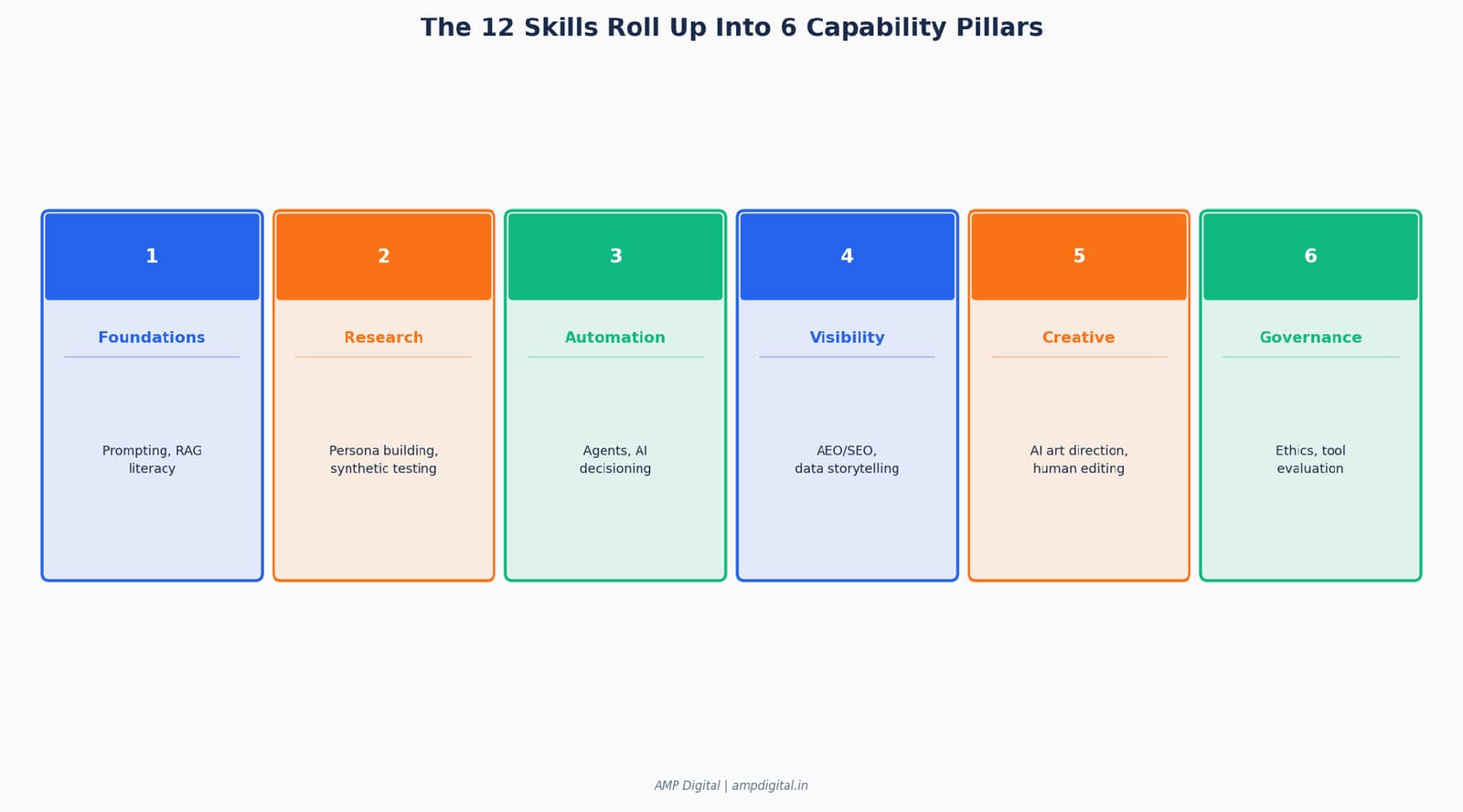
These twelve skills are not a checklist to complete once. They compound: prompt engineering makes RAG output better, RAG makes agent orchestration reliable, and governance skills protect everything the first eleven skills produce.
Common Mistakes That Undercut These Skills
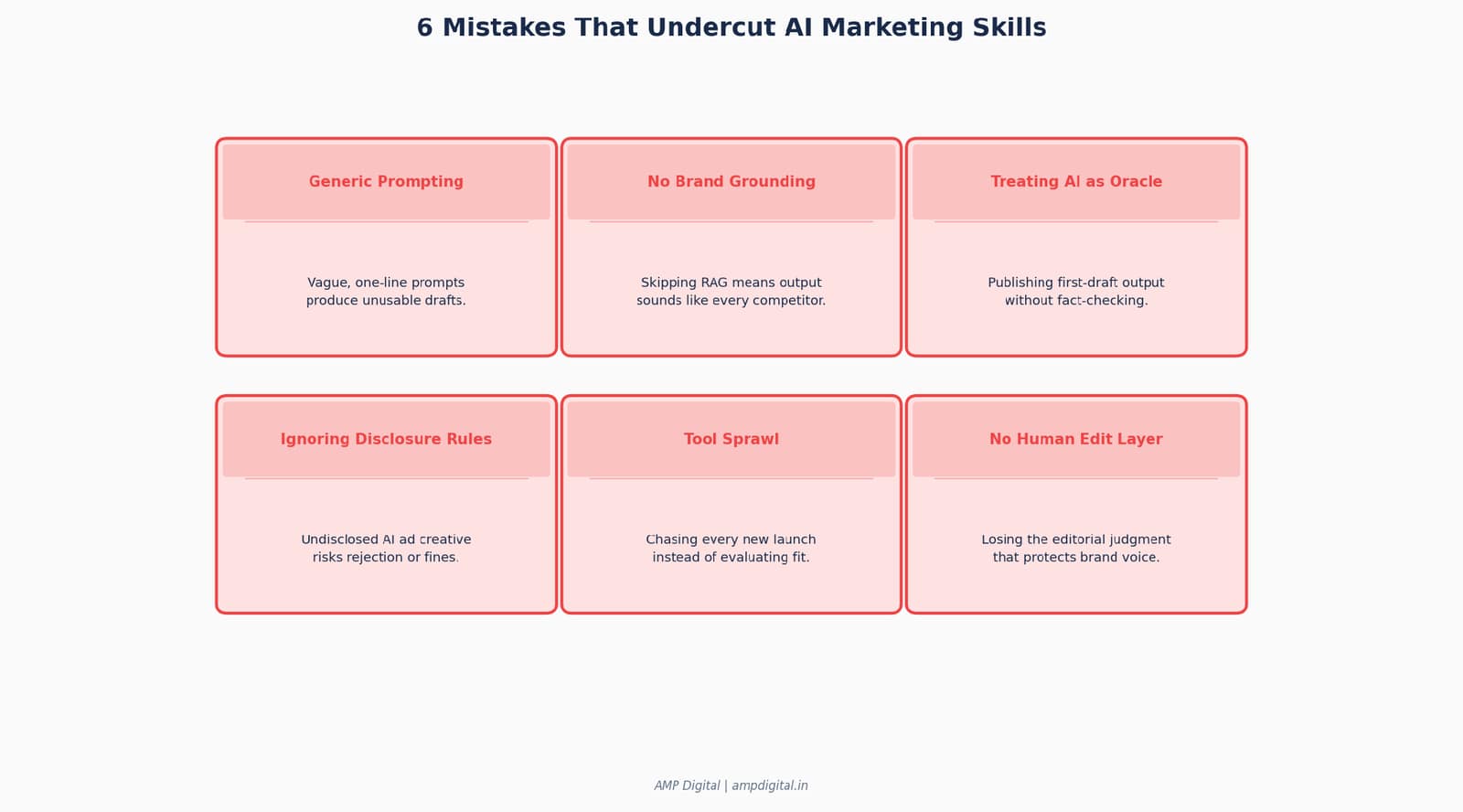
Building AI skill is as much about avoiding predictable failure modes as it is about learning new techniques. The same six mistakes show up across nearly every marketing team still stuck at "single-prompt" maturity.
Mistake | Consequence | Fix |
|---|---|---|
Generic, one-line prompting | Unusable first drafts, wasted iteration time | Build task-specific prompt templates (Skill 1) |
Skipping brand grounding | Output sounds like every competitor | Feed brand data into RAG-literate tools (Skill 3) |
Publishing AI drafts as-is | Factual errors, off-brand tone reach customers | Apply human-AI editorial layer (Skill 11) |
Ignoring disclosure rules | Ad rejection, fines, account restrictions | Build disclosure into the review checklist (Skill 10) |
Advanced Practice: Building the 90-Day Roadmap
Teams that move fastest do not try to build all twelve skills simultaneously. They sequence them, starting with the instruction layer, then grounding, then automation, then governance.
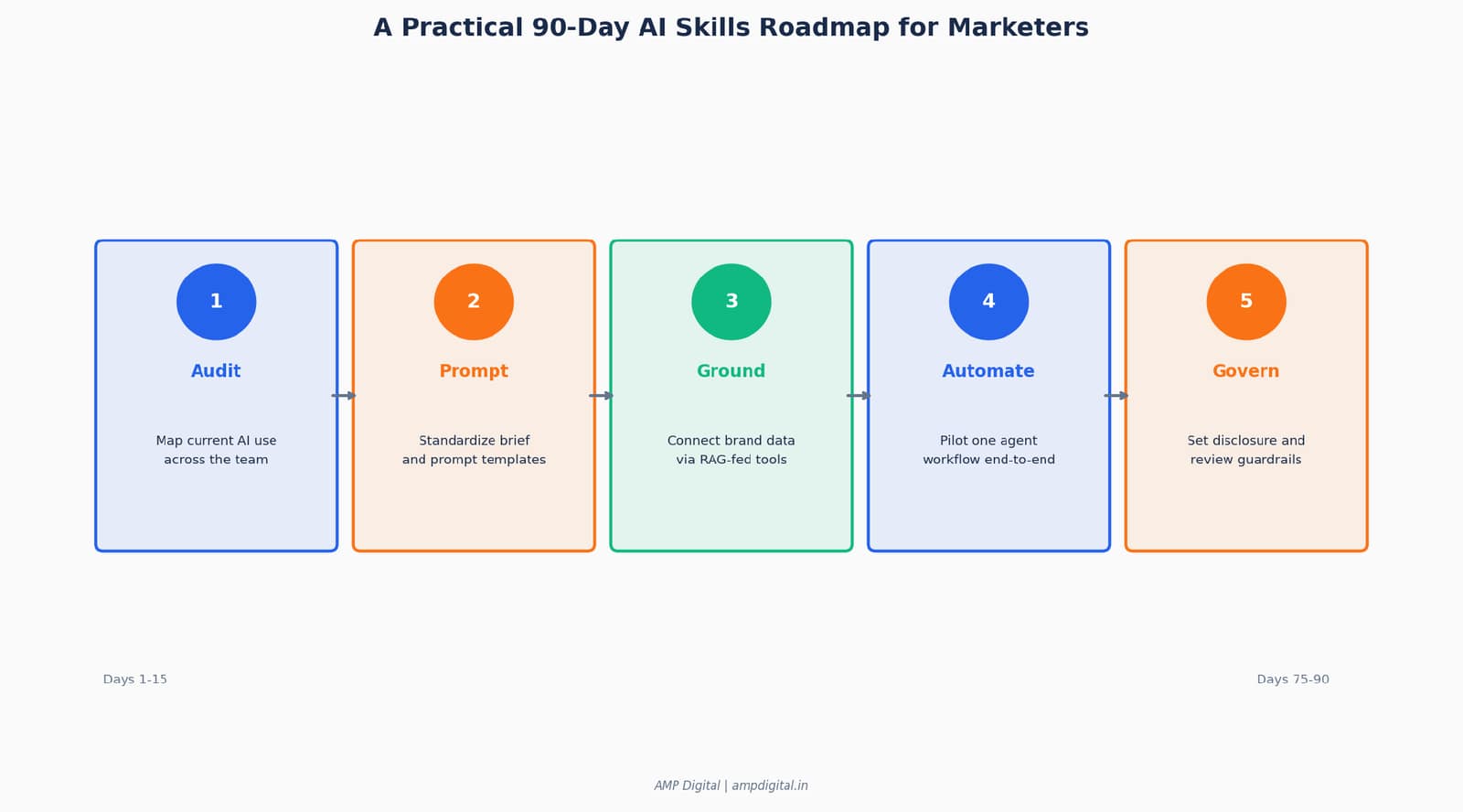
- Days 1–15 — Audit: map exactly which AI tools and workflows the team already uses, informally or otherwise.
- Days 16–30 — Standardize prompting: build a shared prompt library for briefs, ad copy, and segmentation.
- Days 31–50 — Ground the tools: connect brand guidelines and past campaign data via RAG-capable platforms.
- Days 51–75 — Pilot one agent workflow end-to-end, with a named owner and a defined success metric.
- Days 76–90 — Formalize governance: disclosure checklist, fact-check step, and tool evaluation criteria.
Best PracticeCompanies that invest in structured AI education achieve 43% higher project success rates than teams that rely on informal, trial-and-error learning. Sequencing beats speed. Source: Loopex Digital, AI Marketing Statistics 2026 |
|---|
Real-World Examples
Across content, personalization, and audience research, the pattern is consistent: teams that pair AI tools with the specific skill needed to direct them see multiples on ROI that generic AI adoption alone does not produce.
Use Case | Skill Applied | Reported Outcome |
|---|---|---|
Content production scaling | Prompt engineering + RAG literacy | 42% more content published monthly without added headcount (Ahrefs, 2026) |
Personalized email sequencing | AI decisioning | 2.7x ROI on personalization engines (McKinsey Global AI Survey 2026) |
Competitive positioning briefs | Agent orchestration | Multi-step agent workflows now run in production at 34% of enterprise marketing teams |
"65% of marketing teams now have designated AI roles, often focused on AI operations, workflows, or strategy. The most advanced organizations are way beyond piloting and are operationalizing AI at scale." — Jasper, State of AI in Marketing 2026 |
|---|
What Comes Next: 2027 and Beyond
The direction of travel is toward less prompting and more orchestration. Agentic workflows are already running in production at over a third of enterprise marketing teams, up from 14% in late 2025, and that share is expected to keep climbing as agent tooling matures.
UpdateWatch for tighter integration between AEO monitoring and content production — by 2027, expect most marketing teams to track AI citation rates alongside traditional search rankings as a standard reporting metric, not a novelty. |
|---|
Governance is also tightening in parallel with capability. As detection tools expand from images into audio and video, and as regulatory regimes in the EU and US states converge on stricter disclosure requirements, skill 10 (ethics and disclosure literacy) is likely to move from a specialist concern to baseline job requirement across every marketing role that touches paid media.
Frequently Asked Questions
Which AI marketing skill should I learn first?
Prompt engineering for marketing workflows should come first. It is the foundation every other skill builds on — RAG literacy, agent orchestration, and creative direction all depend on being able to structure a clear, task-specific prompt. Most marketers see the fastest improvement in output quality by building a reusable prompt library before investing in any other AI skill.
Do I need to know how to code to use RAG or build AI agents?
No. RAG literacy and agent orchestration, as described in this guide, are about knowing how to configure and direct these systems using no-code or low-code marketing platforms, not about building the underlying retrieval or agent infrastructure yourself. The skill is understanding why grounding and multi-step workflows matter and how to set them up within existing tools.
What is the difference between AEO and traditional SEO?
Traditional SEO optimizes for ranking in a list of links; AEO optimizes for being the direct answer an AI system cites or summarizes. AEO builds on SEO fundamentals rather than replacing them — strong technical SEO still gets content indexed and discovered, while AEO adds the structure, direct-answer formatting, and schema markup that AI systems need to extract and cite that content specifically.
How do I know if my AI-generated content needs a disclosure label?
As of 2026, Meta requires a visible "AI-generated" label on paid content featuring synthetic people, AI-altered product demonstrations, or AI-generated audio and video depicting realistic scenarios. Google requires disclosure of generative AI use in ads, with a manual control for tools outside Google’s own AI systems. When in doubt, disclose to the strictest applicable platform or regulatory standard rather than the minimum requirement of any single platform.
Can synthetic audience testing replace real focus groups?
No. Synthetic audience testing is best used as an early filter to eliminate weak creative concepts before spending media budget, not as a full replacement for live testing. The recommended approach is to use AI simulation to narrow a large set of concepts down to a shortlist, then validate that shortlist with a small live A/B test before committing budget at scale.
How much time does it realistically take to build these 12 skills as a team?
Most teams following a structured sequence, rather than trying to learn all twelve skills at once, see meaningful capability within a 90-day window: roughly two weeks to audit current usage, two weeks to standardize prompting, three weeks to implement grounding, three to four weeks to pilot one agent workflow, and a final two weeks to formalize governance and disclosure practices.
Is it worth hiring a dedicated AI marketing role, or should the whole team upskill?
The data suggests both matter: 65% of marketing teams now have a designated AI role focused on operations, workflows, or strategy, but that role works best as a coordinator and governance owner rather than the only person on the team who understands AI. Broad team fluency in the foundation skills (prompting, RAG literacy) paired with one dedicated owner for orchestration and governance tends to produce the most durable results.
Conclusion
AI access stopped being a competitive advantage the moment every marketer got the same tools. What separates marketing teams now is skill: the ability to prompt with precision, ground output in real brand data, orchestrate multi-step workflows, and govern everything that reaches a customer with the same editorial rigor applied to any other published work.
The twelve skills in this guide are not a certification to earn once. They compound — better prompting makes grounding more effective, grounding makes orchestration reliable, and governance protects the output of all the skills that came before it. Teams that sequence these deliberately, rather than adopting tools and hoping skill follows, are the ones showing up in the 3.2x ROI numbers instead of the 41% who still cannot measure AI’s return at all.
SummaryStarter Checklist — Building Your AI Marketing Skill Stack: ☐ Build a task-specific prompt library for briefs, ad copy, and segmentation ☐ Connect brand guidelines and past campaigns into a RAG-grounded tool ☐ Pilot one multi-step agent workflow with a named owner ☐ Audit content for AEO readiness: direct answers, schema, freshness ☐ Set a disclosure checklist for every platform your ads run on ☐ Assign a human editorial review step to every AI draft before publishing ☐ Build a 4-question evaluation checklist for new AI tools |
|---|
References
- Salesforce. "State of Marketing 2026." Cited in Digital Applied, AI Marketing Statistics 2026: 200+ Adoption Insights.
- HubSpot. "AI Trends for Marketers 2026." Cited in Digital Applied and AI Business Weekly, 2026.
- McKinsey & Company. "Global AI Survey 2026." ROI-by-application data cited in Digital Applied, 2026.
- Jasper. "The State of AI in Marketing 2026." jasper.ai/state-of-ai-marketing-2026.
- Loopex Digital. "AI Marketing Statistics 2026: The Complete Performance Report." loopexdigital.com/blog/ai-marketing-statistics.
- Reboot Online. "AI in Marketing Statistics 2026 | AI Search & GEO." rebootonline.com/ai-in-marketing-statistics.
- TechnologyChecker.io. "AI in Marketing Statistics 2026: 35 Stats on Adoption, ROI and Trust." technologychecker.io.
- Statista. "Marketing Technology Report 2025." Survey of 1,800+ marketing professionals and 200+ CMOs, cited via DGTalents, 2026.
- Bigeye Agency. "Answer Engine Optimization: The Complete Guide to Getting Your Brand Cited by AI in 2026." bigeyeagency.com.
- AirOps. "Answer Engine Optimization (AEO): Your Complete Guide for 2026." airops.com/blog/aeo-answer-engine-optimization.
- Frase.io. "Answer Engine Optimization: Complete AEO Guide 2026." frase.io/blog.
- AuditSocials. "Meta AI Content Label Policy 2026: Detection & Disclosure." auditsocials.com.
- BGBlur. "AI Ad Disclosure: Meta, Google, TikTok & NY Law Guide 2026." bgblur.com/blog.
- ppl.studio. "FTC AI Content Disclosure Rules 2026: What Brands Must Say." ppl.studio/blog.
- HumanAdsAI. "FTC AI-Generated Content Disclosure: 2026 Rules Explained." humanadsai.com/blog.
- MediaNama. "Google Requires Advertisers to Disclose Generative AI Use in Ads." medianama.com, 2026.
- Searchlab. "AI Marketing Statistics 2026 | 50+ Data Points & Insights." searchlab.nl.
- The Stacc. "AI in Marketing Statistics 2026: 91% of Teams Use AI." thestacc.com/blog/state-ai-marketing.